The history of the Dutch language spans over 1,500 years of fascinating linguistic evolution, from its humble beginnings as a collection of Germanic dialects to its current status as the official language of the Netherlands, Belgium, Suriname, and several Caribbean islands. With approximately 24 million native speakers and 5 million second-language speakers worldwide, Dutch represents a crucial bridge in the West Germanic language family, linguistically positioned between English and German.
Key Takeaways
- Dutch is a West Germanic language that evolved from Frankish dialects around 500 AD.
- The language’s closest relatives are Frisian and English, not German, as commonly assumed.
- The Statenvertaling Bible (1637) was important in the standardisation of the Dutch language.
- Afrikaans, spoken by 7 million people in South Africa, evolved directly from 17th-century Dutch.
- Modern Dutch exists in two main variants: Netherlands Dutch and Belgian Flemish.
The Origin of the Dutch Language: Proto-Germanic Roots
The history of the Dutch language traces back to approximately 500 BCE when Proto-Germanic, the ancestor of all Germanic languages, was spoken across what is now Denmark, southern Scandinavia, and northern Germany. This ancient tongue served as the common foundation for English, German, Swedish, Norwegian, and Dutch.
Understanding the Dutch language background isn’t just an academic exercise. For businesses expanding into the Netherlands or Belgium, knowing this language becomes necessary, and it becomes more important to translate the documents into this language, and that is where Translation Services UK comes to your rescue.
Old Dutch: The Beginning of a Distinct Language (500-1150)
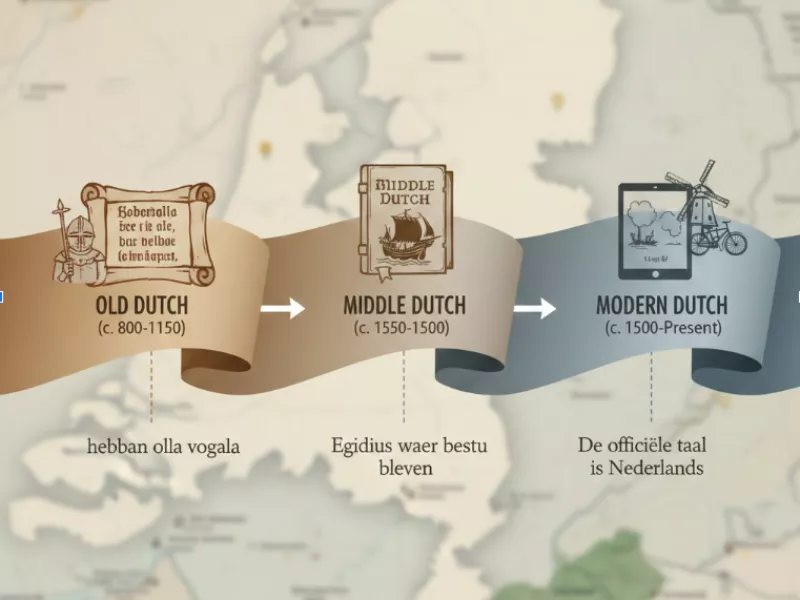
Old Dutch language emerged as a recognisable entity around 500-600 AD, marking the point where Franconian dialects evolved into something distinctly “Dutch.” During this period, three main dialect groups dominated the region:
- Lower Franconian (centre-south regions)
- Lower Saxon (eastern territories)
- Frisian (northern coastal areas)
The most famous example of Old Dutch is the sentence “Hebban olla vogala nestas hagunnan” (Have all birds begun nests…), dating from around 1100 AD. Discovered in a manuscript written in Rochester, England, this phrase is widely regarded as one of the oldest literary sentences in the Dutch language and represents an important moment in the development timeline of the Dutch language.
During the Early Middle Ages, as Christianity spread across the Low Countries in the 7th century, written documentation began appearing. However, most evidence from 600-800 AD consists only of place names and runic inscriptions. The introduction of literacy accelerated the standardisation of Dutch language processes that would unfold over subsequent centuries.
This period also saw Dutch language influences from Latin (through Christianity), Old Norse (from Viking incursions), and neighbouring Germanic dialects—all contributing to the vocabulary richness we see in modern Dutch.
Middle Dutch and Regional Diversity (1150-1500)
Middle Dutch wasn’t one uniform language but rather a collection of mutually intelligible dialects spanning the Low Countries. Four major dialect groups dominated:
- Flemish (modern-day Belgium)
- Brabantic (Antwerp and surrounding regions)
- Hollandic (Holland province)
- Limburgic (southeastern regions)
For anyone requiring professional translation services for historical documents from this period, understanding these regional variations becomes crucial, as Middle Dutch texts vary considerably depending on their geographic origin. Likewise, people staying in such locations as Latin America, Amsterdam, etc, need Italian translation services . For that, you will get the best help.
Standardisation of Dutch Language
The Statenvertaling: A Linguistic Milestone
The important moment in the standardisation of Dutch language came in 1637 with the completion of the Statenvertaling, the authorised translation of the Bible into Dutch. Commissioned by the Dutch Reformed Church, this translation drew primarily from the Hollandic dialect while incorporating elements from other regional variants.
There’s a saying that captures this evolution perfectly: “Dutch was born in Flanders, grew up in Brabant, and matured in Holland.” This phrase encapsulates how the Dutch language development timeline flowed northward, ultimately centring on Holland’s urban dialects.
The 1585 Fall of Antwerp: A Turning Point in the History of the Dutch Language
When Spanish forces conquered Antwerp in 1585, thousands of Dutch-speaking refugees fled northward to Holland. These migrants brought their Brabantian urban dialect with them, which heavily influenced the emerging standard Dutch. This event was crucial to the history of the Dutch language, as it explains why modern standard Dutch strongly resembles 16th-century Brabantian, even though it’s based on Hollandic grammatical structures.
Spelling Reforms and Continued Evolution
The evolution of the Dutch language didn’t stop with the Statenvertaling. Spelling remained contested until 1804, when the first official orthography was established. Even this proved controversial, linguists De Vries and Te Winkel simplified it in 1863, and further reforms followed in 1946. The most recent spelling modification came with the Spelling Act of 2005, currently governing official Dutch language use in government and education.
For organisations needing accurate Danish content, working with experienced Danish translation service providers ensures compliance with current standards.
Why Dutch Is Between English and German?
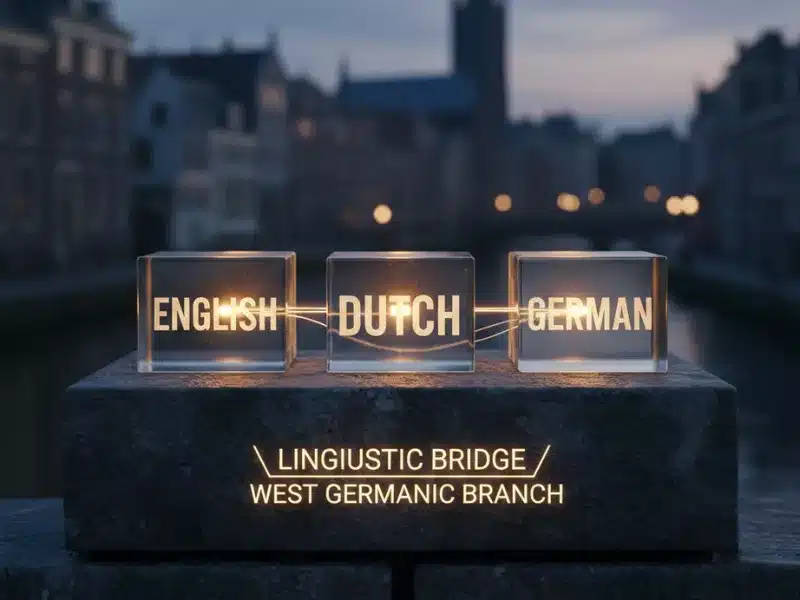
One of the most fascinating aspects of the Dutch language is its position between English and German, both grammatically and lexically. Here’s why linguists describe Dutch as linguistically “in between”:
Similarity to English:
- No High German consonant shift (unlike German)
- Simpler grammar than German (fewer case endings)
- Extensive shared vocabulary from common West Germanic roots
- More straightforward verb conjugation patterns
Similarity to German:
- Grammatical genders (de/het system similar to der/die/das)
- Word order patterns in subordinate clauses
- Compound word formation (though shorter than German)
- Pronunciation of certain consonants
|
Word |
English |
Dutch |
German |
|
House |
House |
Huis |
Haus |
|
Water |
Water |
Water |
Wasser |
|
Good |
Good |
Goed |
Gut |
|
Bread |
Bread |
Brood |
Brot |
|
Night |
Night |
Nacht |
Nacht |
The Afrikaans Connection: Dutch in South Africa
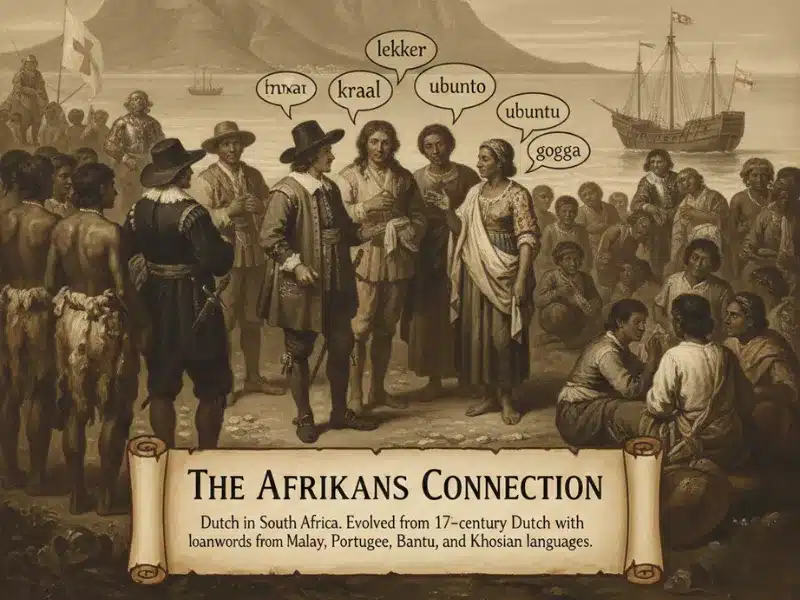
No discussion of the history of the Dutch language would be complete without exploring Afrikaans, the daughter language that evolved from 17th-century Dutch in the Cape Colony of South Africa.
How Afrikaans Developed?
When Dutch settlers established the Cape Colony in 1652, they brought the Southern Holland dialect with them. Over the next three centuries, this colonial Dutch evolved in isolation, incorporating loanwords from:
- Malay (from enslaved people brought from Southeast Asia)
- Portuguese (from earlier Portuguese explorers)
- Bantu languages (from indigenous African peoples)
- Khoisan languages (from the indigenous Khoi and San people)
Despite these influences, Afrikaans remains approximately 90% mutually intelligible with modern Dutch. Dutch speakers can generally understand written Afrikaans with minimal difficulty, though the spoken forms diverge more significantly due to pronunciation differences.
Modern Dutch: Regional Differences Between the Netherlands and Belgium
The modern Dutch language exists in two primary standard forms: Netherlandic Dutch (Nederlands) and Flemish Dutch (Vlaams or Belgian Dutch). While mutually intelligible, key differences exist:
Belgium’s Unique Journey in the History of the Dutch Language
The standardisation of Dutch language in Belgium followed a dramatically different path. When Spanish, Austrian, and French powers occupied the Southern Netherlands (modern Belgium and Luxembourg), centralised standardisation halted. French became the administrative language from 1795-1814, even though 60% of the population spoke Dutch. This political turbulence significantly shaped the history of the Dutch language in the region. Meanwhile, you can learn more about Scandinavian languages here.
Why You Need Region-Specific Translators?
At Translation Services UK, we recognise that effective Dutch translation services require regional specialisation:
- Marketing Impact: A campaign created for Dutch consumers may not resonate or could take offence in Belgium. The direct, casual tone that works in the Netherlands often seems inappropriate in more conservative Belgian markets.
- Legal Compliance: Belgian legal Dutch contains French-origin terminology reflecting different legal systems. Contracts and regulatory documents must be translated by specialists familiar with each region’s requirements.
- Technical Accuracy: Medical and technical documentation requires region-specific terminology and compliance with separate regulatory bodies in each country.
- Brand Perception: Using a generic “Dutch” translation for both markets risks appearing culturally unaware, reducing conversion rates, and damaging brand credibility.
Fascinating Things To Know About The Dutch Language
English speakers used the term “Dutch” to describe Germans and persons from the Netherlands. People from the hilly territory, now southern Germany, were known as “High Dutch,” while those from the flat region, now the Netherlands, were known as “Low Dutch.”
The Dutch language history is distinctive and has many intriguing aspects. According to legend, the first printed Dutch text was a poem created in the 12th century as a literary experiment. Dutch is most likely between English and German in terms of complexity. Here are some exciting things to know about the Dutch language.
- Deutsch is the German name for the German dialects, whereas Dutch is the English word for the Dutch language. Native Dutch speakers can genuinely comprehend much German, whereas Germans can comprehend Dutch very well.
- Many Dutch words seem more like tongue twisters than words because they have many consonants that come after each other. In the British world, waffles are now a common breakfast item, but the word is from the dutch origin language, wafel. It’s fascinating to note that coleslaw also has Dutch roots.
- The English language has several well-known terms with Dutch roots, including “cookie,” “easel,” “freight,” and “yacht.” The name “Dutch” comes from the Medieval term Dietsc, or possibly Duutsc, which means “language of the people.”
- It could be necessary to adapt documents to the long compound terms used in Dutch from English. The Dutch have incorporated a few Hebrew words into their language and added accents to flavor it.
- It is true that several other languages, primarily French and Hebrew, have accused the Dutch language of “stealing” its terminology. The word “awkward” earned a prize because it is the most alluring English word used in Dutch and is regularly brought up in dutch language courses London.
Conclusion
The history of the Dutch language represents a remarkable journey from ancient Frankish dialects to a modern, standardised language spoken by millions worldwide. From the earliest Old Dutch fragments and the beloved “Hebban olla vogala” verse through the transformative Statenvertaling to contemporary global Dutch communities, the language has demonstrated remarkable resilience and adaptability.
Understanding Dutch linguistic history illuminates broader patterns in European cultural development, colonial expansion, and language evolution. For businesses requiring language translation services for Dutch markets, appreciating this historical context ensures culturally sensitive, accurate communication that respects regional variations between the Netherlands and Belgium.
Frequently Asked Questions (FAQs)
What are the key phonological changes from Middle Dutch to Modern Dutch?
Key phonological changes from Middle to Modern Dutch include the diphthongisation of long mid vowels, the loss or weakening of many final unstressed vowels, and further reduction of case endings that had already begun in Middle Dutch. Consonant clusters were simplified in some environments, and stress patterns became more fixed on the root syllable, contributing to a clearer syllable structure in the modern language.
When did Afrikaans diverge enough to be seen as separate?
Afrikaans began diverging noticeably from European Dutch in the 18th century, when features like loss of grammatical gender and simplification of verb conjugation became widespread in the Cape Colony. It was increasingly treated as a separate language in the late 19th and early 20th centuries, and in 1925, the South African government recognised Afrikaans as distinct from Dutch in official use.
Is Dutch hard to learn for English speakers?
No, Dutch is considered one of the easiest languages for English speakers to learn. The Foreign Service Institute classifies it as a Category I language (requiring 600-750 hours to reach proficiency). Dutch and English share extensive vocabulary, similar grammar structures, and both avoid many of the complexities present in German, making Dutch relatively accessible to English speakers.
Is Dutch older than German?
No, Dutch and German evolved simultaneously from West Germanic dialects beginning in the 5th-6th centuries CE. They represent parallel developments rather than one predating the other. However, Dutch preserved some features of West Germanic that German changed through the High German consonant shift, making Dutch “more conservative” in certain respects.
Why Dutch is a Germanic language?
Dutch is classified as a Germanic language because it descends from Proto‑Germanic, the common ancestor of German, English, and the Scandinavian languages, and shares the sound shifts and core grammar that define this family. More specifically, it belongs to the West Germanic branch—alongside German, English, and Frisian- and developed from Old Frankish/Old Low Franconian, which did not undergo the High German consonant shift, keeping it closer to other Low Germanic varieties.
How much do translation services cost per page?
A standard professional translation starts from about £15 per page, while certified translations for legal or official use typically start from around £25 per page, with exact prices depending on complexity and language pair.
Which industries do you support?
Services cover legal, medical, immigration, government, financial, e‑commerce, industrial, IT, travel, and other sectors, matching each project with translators who have domain expertise.
How will I receive my translation?
Completed translations are delivered as professionally formatted digital PDF files to your email, and certified translations include the necessary stamp and signature for official acceptance.
Previous Post – A History of the Russian Language

Want To See My Profile — Check Now
- The History of Mandarin Chinese Language - 31st January 2026
- The History of the Dutch Language: From Old Dutch to Afrikaans - 23rd December 2025
- A History of the Danish Language - 31st May 2017