Creole languages form a unique category of human communication. They emerge from intersecting cultures and linguistic systems. They do not descend from a single parent language. History shaped them through colonisation, slavery, and global trade. These conditions drive a process linguists call creolisation. The process starts with a pidgin for basic communication. Later generations adopt it as a developed native language. In this article, we will discuss everything from what is a Creole Language, and its historical evolution to the language varieties.
Key Takeaways
- Unlike dialects, Creoles are new linguistic systems that blend “superstrate” (typically European language) and “substrate” (Indigenous, African, or Asian) influences.
- They are characterised by simplified grammar and streamlined phonology. They also include creative lexical adaptations such as reduplication, where a word or part of a word is repeated for emphasis or to change meaning. For example, in Jamaican Creole, the phrase “likkle-likkle” means “very small” or “a little bit.”
- Creoles serve as vital symbols of identity and resilience. It is particularly for communities shaped by the displacement of the slave trade or colonial expansion.
- Haitian Creole stands as the most widely spoken. Cape Verdean Creole is the oldest living example.
- The roots of most creole languages are found in French, English, or Portuguese.
What Is a Creole Language?
A Creole language is a complete, complex language. It emerges in multilingual settings. Especially, where populations lacking a common tongue must establish mutual understanding. These languages are products of significant historical movements and cultural interactions.
i. Creole Language Definitions
- According to Wikipedia, a creole language develops from pidgins. It stabilises as speakers mix two languages together. Over time, communities adopt it as everyday speech.
- The Columbia Encyclopedia agrees and notes that it becomes a mother tongue, replacing the former languages previously spoken.
A Creole Language has its specific grammar rules and vocabulary. In fact, speakers of the parent language often cannot fully understand Creole. They need to learn it as a separate language, and if not, they need Translation services in the UK to fill the gap.
ii. How do Creole Languages form? The Framework Explained
The creole formation is typically a generational process involving two distinct stages:
- Pidgin Stage: Pidgin is a simplified communication system. This is a simplified language with limited vocabulary and rudimentary grammar. Speakers of different languages use it for practical purposes (e.g., trade). However, it is not anyone’s native language.
- Creolisation (Nativisation): When children learn a pidgin as their first language, creolisation begins. The language expands its vocabulary to meet daily needs. Speakers develop richer grammar and clearer sentence structures. It grows into a complete primary language over time. The language expresses complex ideas, identities, and social needs.
Creole Language History: The Evolution Over The Centuries
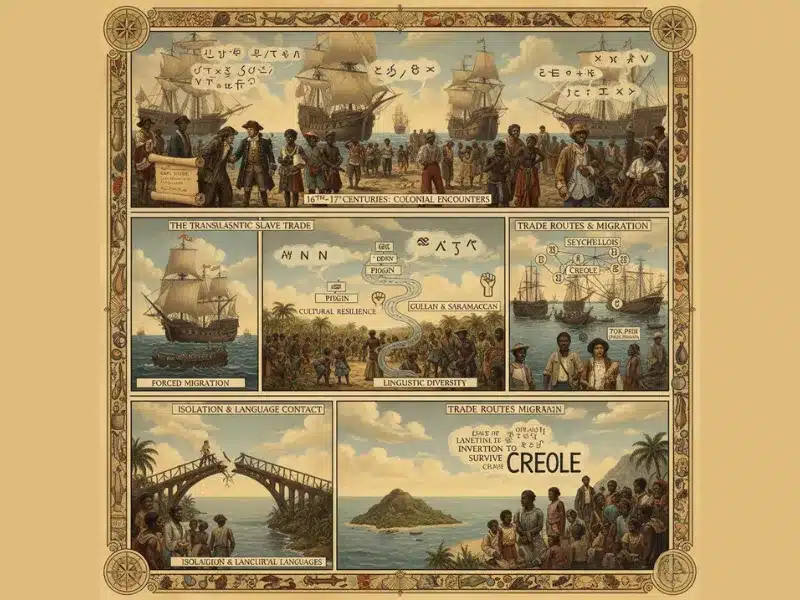
Creole languages are inextricably linked to historical events, where pidgins developed and turned into creole:
Colonial Encounters
While modern organisations now rely on Language translation services to navigate such barriers, this historical need led to the development of pidgins, which eventually evolved into Creoles.
In most cases, they appeared in Atlantic coasts. They also emerged in slave-depots in Cape-Verde and Lesser-Antilles.
The Transatlantic Slave Trade
Colonisers forcefully enslaved and brought Africans from diverse linguistic backgrounds to the Americas and the Caribbean colonies. This settlement led to the development of pidgins. Over generations, children adopted these pidgins as native languages.
The languages evolved into stable Creoles like Gullah and Saramaccan. These Creoles remain strong symbols of cultural resilience today.
Trade Routes and Migration
In the Indian Ocean and Southeast Asia, trade and labour migration facilitated the meeting of different language groups. For example,
- Seychellois Creole emerged from the interactions of European traders, African slaves, and Asian labourers.
- Tok Pisin in Papua New Guinea similarly developed through trade and labour migration.
Isolation and Language Contact
There were some instances where communities lost access to their ancestral languages. According to Britannica, linguists have explained the development of creole languages through major theories such as the substrate, superstrate, and universalist hypotheses, rather than suggesting they were simply invented out of contact with unrelated languages.
Shared Features of Creole Languages Explained
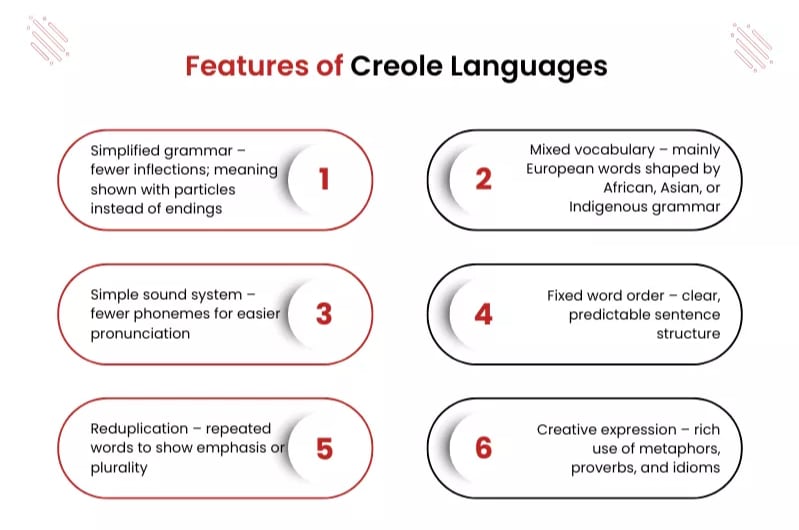
Although the creole languages have varying geographical backgrounds, similar features are common to the characteristics of the creole languages. These were due to the need to have effective inter-barrier communication.
- Simplified Grammars: Creoles tend to evade complicated verb conjugation and inflexions. They minimise tense, number, and case marks. Instead of suffixes, Creole speakers use separate particles or words to formulate grammar.
- Vocabulary Fusion: These languages borrow words from various languages in the world. Most core vocabulary is often provided by the European superstrate languages. African, Asian, or Indigenous substrate languages shape grammar terminology.
- Streamlined Phonology: Creole sound systems are usually simpler than parent languages. They have reduced phonemes to allow easy pronunciation. This assists people with other language backgrounds to understand each other.
- Fixed Word Order: An order of words that is predictable and intuitive makes these languages easier to use and learn.
- Reduplication: This is a special characteristic when words or fragments of words are used repeatedly to obtain new meanings. This signifies plurality, or stress (e.g., Jamaican Creole Patois likkle-likkle meaning very small).
- Creative Expression: Speakers make a lot of use of metaphors, proverbs, and idioms. These phrases are the cultural values and experiences of the community.
Examples of Creole Languages Around the World
The languages of Creole are commonly characterised by their substrate or base language. Some examples of each type are as follows:
French-Based Creole Languages
Many of these varieties originate from historical French influence, which is why modern French translation services are often required when working with related documents or linguistic research.
| Creole | Interesting Facts | Examples |
| Haitian Creole |
|
|
| Louisiana Creole |
|
|
| Mauritian Creole |
|
|
Creoles Based on English
| Creole | Interesting Facts | Examples |
| Jamaican Patois (Patwah) |
|
|
| Tok Pisin |
|
|
| Guyanese Creole |
|
|
| Kriol |
|
|
Portuguese and Mixed-Base Creoles
| Creole | Interesting Facts | Examples |
| Papiamento |
|
|
| Cape Verdean Creole (Kriolu) |
|
|
End Note on Cultural Significance
In brief, the creole languages have maintained a unique heritage throughout the centuries. They are much more than a communication tool. They are great conveyors of identity and solidarity. They represent the history of oppressed communities, including slavery and colonisation. Through preserving oral traditions, folklore, and ancestral wisdom, Creole languages have added value to the diversity of culture in the world and the beauty of the human linguistic world. For example, Haitian Creole proverbs such as “Dèyè mòn gen mòn” (Behind mountains, more mountains) reflect resilience in the face of hardship and are passed down generations as both wisdom and comfort. In Mauritius, the Sega song tradition sung in Mauritian Creole expresses stories of struggle and hope, keeping alive the emotional memory of ancestors through music and poetry. These living examples show how Creole languages are woven into the cultural fabric and collective memory of their communities.
Frequently Asked Questions
Is Creole a Dialect?
No! Dialect is a local variation of an existent language. It can usually be understood by other speakers of that language. On the contrary, Creole is a language of its own. The grammatical form and vocabulary of a Creole are usually so different that its language cannot be understood by speakers of the original language unless they study it.
What Does the Term “Creole Language” Mean?
Creole has a Latin root, Creare. This means to beget or create.
Are Creole Languages Considered Real Languages?
Yes, linguists consider creole languages fully functional and real. They recognise them as real languages with complete systems.
Why Aren't All Languages Considered Creoles?
Not every language is a Creole by definition. Creole groups are created quickly as a result of simplified inter-group pidgins. They are subsequently adopted as a native language by children. Most natural languages, like Mandarin, evolve gradually across long historical periods. Creoles emerge under slavery or plantation conditions through merging.
What are some everyday phrases or words in well-known Creole languages?
Common examples include “Sak pase?” (Haitian Creole: How’s it going?), “Wetin dey happen?” (Nigerian Pidgin: What’s happening?), and “Bon bini” (Papiamento: Welcome).
Where are Creole languages spoken today, and how widely are they used in daily life?
Creoles are spoken globally, notably in the Caribbean, West Africa, the Indian Ocean, and the Pacific.
How do Creole languages influence music, literature, or popular culture in their regions?
They are the heartbeat of regional identity, driving global music genres like Reggae, Dancehall, and Afrobeat. In literature and social media, Creoles provide a unique, authentic voice for storytelling and poetry that traditional colonial languages cannot replicate.
Is it difficult for outsiders to learn a Creole language? Are there resources for beginners?
They are relatively accessible because of their simplified grammar and familiar vocabulary. Beginners can find resources through apps like Duolingo (for Haitian Creole), YouTube tutorials, and specialised phrasebooks or community-led online courses.

Want To See My Profile — Check Now
- Good Morning in Every Language: Your Complete Global Greeting Guide - 12th March 2026
- A Guide to Constructed Languages: What They Are and How Many Are There? - 9th March 2026
- What Is a Creole Language? History, Characteristics, & Types - 20th February 2026