
Mandarin Chinese is the culmination of a common thread of language stretching back more than 3,000 years. As of 2026, Mandarin Chinese stands as the world’s most spoken native language with over 1.1 billion total global speakers representing a linguistic legacy that began with divinatory inscriptions on oracle bones from 1250 BCE. In this article, we will briefly discuss the history of the Mandarin Chinese language.
Key Takeaways
- The Mandarin Chinese language originates from the Proto-Sino-Tibetan family, dating back over 3,500 years.
- Modern Chinese uses Simplified characters (Mainland/Singapore) and Traditional characters (Taiwan/HK).
- Standard Mandarin is specifically modelled after the Beijing dialect, codified in 1932.
- Mandarin is a tonal, analytic language that lacks the complex conjugations found in European languages.
History of Mandarin Chinese Language
Mandarin Chinese history is generally divided into dynastic periods based on the dynasties of emperors. Old Chinese evolved from various prehistoric languages, with the first dynasty, the Xia, emerging around 2100 BC. For modern researchers and businesses requiring professional Translation services uk, understanding the ancient origin of Mandarin is the first step in appreciating the depth of the Sinitic branch.
It’s generally agreed that Old Chinese can be traced to the Proto-Sino-Tibetan language family, which covers much of northern and central Asia. Specifically, linguists point to Proto-Sino-Tibetan as the ancestral root shared between the Sinitic and Tibeto-Burman branches. Linguists point to this ancestral tongue as dating back roughly 4,500 years.
Therefore, Chinese is the most common of the Sinitic language branch. This complexity is why specialised Language translation services are often necessary to navigate the cultural nuances between the ancestral Proto-Sino-Tibetan roots and modern dialects.
Prehistoric Origins
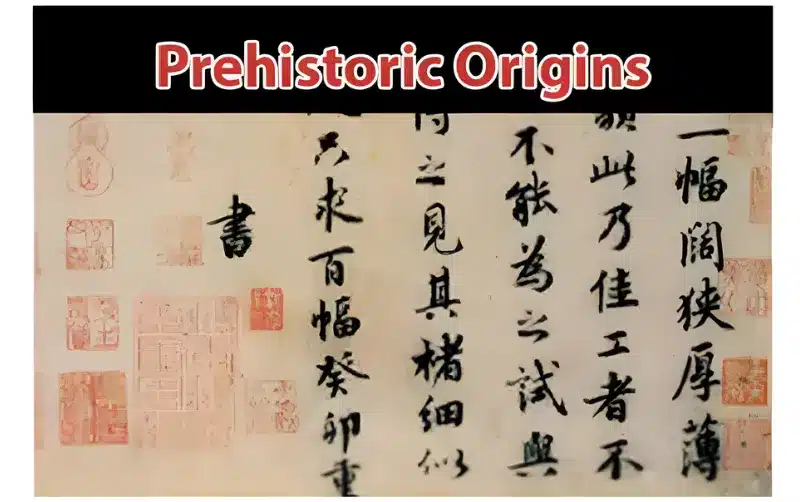
Old Chinese was the language of the Shang dynasty (1600-1046 BC). The Zhou dynasty (1046-476 BC) overthrew them and the subsequent Warring States period until beginning to die out after 221 BC with the Qin unification.
The oldest Chinese literature dates back to the Zhou period and Old Chinese forms the basis of Literary Chinese. Literary Chinese and Mandarin developed out of the languages spoken around the capital on the North China plain. Which remained the written standard until the early 20th century.
Because the language remained a moving target of oral and written shifts until the 20th century, achieving an accurate Mandarin Translation today requires a deep understanding of this evolution from vernacular speech to a unified standard.
While oracle bones (c. 1250 BCE) provide the earliest script, the Zhou Dynasty bronze inscriptions are considered the first examples of significant literature. In particular, the oldest parts of the Book of Documents, the Classic of Poetry and the I Ching are some of the most well-known of these documents.
Old Chinese began to shift into Middle Chinese after the Warring States period. However, the vast size and diversity of China meant that there’s no such thing as a universal language – Middle Chinese came in a wide variety of dialects, many not mutually intelligible with each other.
Middle Chinese began developing as the language of three dynasties between 600 and 1100 AD, spoken by the Sui, Tang and Song dynasties. Most modern knowledge of this language comes from the Qieyun, a dictionary from 601, which is notable for its awkward fanqie method of indicating punctuation.
The Qieyun forms the basis of early Middle Chinese, while the Yunjing, a later 12th century rime table, is considered to refer to Late Middle Chinese, a separate stage of development. Middle Chinese formed a basis for many modern Chinese dialects, was highly influential across the region, with elements discernible in early Japanese, and modern Mandarin can be considered a divergent development of it.
The Early Modern Dynasties

Old Mandarin emerged as the language of northern China during the Jin (1115-1234) and Yuan (1271-1368) dynasties, beginning in 1115. The origin of mandarin chinese language saw a reorganisation of the four tones of Middle Chinese and other features characteristic of modern Mandarin dialects.
At a Glance: Chronology of Mandarin Evolution
- c. 1250 BCE: Earliest Oracle Bone inscriptions provide evidence of Old Chinese.
- 1115–1368: Old Mandarin emerges in North China under the Jin and Yuan dynasties.
- 1324: The Zhongyuan Yinyun rime dictionary codifies the first Mandarin-like phonology.
- 1913: The Commission on Unification sets the standard Beijing-based dialect as the official speech.
- 1956: The official Character Simplification campaign begins to boost literacy.
But it was likely not itself referred to as a variant of ‘Mandarin’ as that term was based on various northern dialects. Sources covering the development of Old Mandarin are limited thanks to a strong and conservative Chinese tradition of phonological description in rime dictionaries, dictionaries that collate Chinese characters by tone and rhyme.
Mandarin survived through the Mongol invasions that founded the Yuan dynasty (1271-1368) and developed as a common speech. While it is not a creole language, its evolution was significantly shaped by the need for a simplified, shared tongue among diverse populations.
It was based on the dialects of the North China Plain around the capital. The Mongol invasion shook up traditional Chinese cultural conservatism and led to new genres of poetry and drama, such as the Qu and Sanqu poetry.
This was, in turn, codified by the Zhongyuan Yinyun of 1324, a rime dictionary that contains plenty of information about the phonology of old Mandarin. Tibetan alphabet records from the Mongol Imperial period, the ‘Phags-pa script in particular, and also contain information from this period.
Written Vernacular Chinese developed as a means of writing down material to be presented orally. By this point, the heavily divergent Literary Chinese language was unsuitable, also showing heavy Mandarin influences.
The Middle-Aged Dynasties & Etymology

The later post-Mongol Ming and then the Manchu Qing dynastic governments saw when mandarin became official and court language. During the Ming Dynasty (1368-1644), the Beijing dialect was promoted in the imperial court, and by the Qing Dynasty (1644-1912), it became the official language of the elite bureaucracy. With China’s size, adopting a court language was necessary. As thousands of mutually unintelligible dialects were spoken across the country, no official could be expected to learn them all.
The name ‘Mandarin’ came about as a reference to the fact that Chinese officials spoke it. The word itself stems from the Portuguese term “Mandarim,” which was adapted from the Sanskrit word “mantrin” (meaning counsellor or minister). By the 16th century, Jesuit missionaries popularised this term in Europe to describe the Imperial speech.
The common language used throughout this period was a Mandarin-derived tongue called Guānhuà, literally “Officials’ Speech,” which still ran into regional difficulties.
A decree from 1728 demanded that officials from Guangdong and Fujian be taught proper pronunciation as their reports were becoming impossible to understand. By the 19th century, the Beijing dialect had become essential for a court official to understand. Especially given the divide in the court between ethnic Han Chinese left over from the Ming government and the newly arrived Qing leadership.
The Republic Era & Standardisation (1912-1949)
The fall of the Qing in 1911 and the establishment of the Republic of China in 1912 led to the most critical era for linguistic unification:
- 1913: The ‘Commission on the Unification of Pronunciation’ was convened to resolve dialect disputes.
- 1918: The Zhuyin (Bopomofo) alphabet was adopted as the official phonetic system for education.
- 1920: The Dictionary of National Pronunciation was published.
- 1928: The term “Guoyu” (National Language) was popularised to define the standardised tongue.
- 1932: The Beijing dialect was officially adopted as the National Standard.
Modern Standardisation and Literacy

Following the Chinese Revolution, the fall of the Qing in 1911, and the eventual victory of the communist government in 1949, Mandarin began spreading more rapidly with the advent of modern communications systems. It was previously limited in China due to the war and Qing isolationism.
In 1955, Modern Standard Chinese was officially established by the National Language Reform Committee. This was a monumental achievement: in the 1950s, it is estimated that only 11% of non-Mandarin speakers understood the standard tongue. By 1984, that figure reached 54%, and as of 2020, literacy and standard comprehension crossed the 80% milestone.
Needing a common language for the purposes of propaganda and communication, the new communist government drew up Standard Chinese. A language based on the Beijing dialect with vocabulary drawn from the Mandarin dialects.
THE SIMPLIFICATION REFORM (1949-1956)
To combat a staggering illiteracy rate that reached nearly 90% in 1949, the government began simplifying traditional characters between 1949 and 1956. By reducing the complexity of strokes, the reform drastically increased reading rates. This led to today’s geographic divide: Simplified characters are standard in Mainland China, Singapore, and Malaysia, while Traditional characters are still used in Taiwan, Hong Kong, and Macau.
In modern terms, ‘Mandarin’ is used interchangeably to refer to both Standard Chinese and the large collection of dialects spoken across Northern and Southwestern China. This collection is generally divided into four major regional subgroups:
- Northern Mandarin: Spoken in Beijing and throughout Northeast China.
- Northwestern Mandarin: Extending from Baoji through Northwest China.
- Southwestern Mandarin: Centred around Chongqing and the Sichuan province.
- Lower Yangtze (Southern) Mandarin: Primarily used in the areas around Nanjing.
Some linguists refer to Standard Chinese as Modern Standard Mandarin to distinguish the current state of the shared language from other dialects.
How Old Is the Mandarin Language?

Mandarin is also known as Standard Chinese. The earlier form of spoken Mandarin was developed about eight hundred years ago in Northern China.
Which influenced neighbouring dialects like Mongolian and Manchurian. You can consider it the Mandarin language origin. In the next few centuries, the language developed and became the prime dialect of Beijing. It was called “Putonghua” (普通话), which means “Common Speech.”
Linguistic Evolution: Old Chinese vs. Modern Mandarin
| Feature | Old Chinese (c. 1250 BCE – 221 BCE) | Modern Mandarin (Standard Chinese) |
| Tone System | Generally believed to have no tones; meanings were changed by suffixes. | Tonal language using 4 distinct pitches (plus a neutral tone). |
| Consonant Sounds | Complex (could have double consonants like st- or bl-). | Simple (strictly one consonant followed by a vowel; no clusters). |
| Word Structure | Monosyllabic: One character/sound was almost always one full word. | Disyllabic: Over 70% of words are compounds made of two or more characters. |
| Primary Script | Oracle Bones, Bronze inscriptions, and Seal scripts. | Simplified & Traditional characters supported by the Pinyin system. |
| Literacy Mode | Literary Chinese: Extremely terse; written for the elite/officials. | Vernacular: Written to match exactly how people speak today. |
| Primary Function | Divination, ritual, and early classical poetry (I Ching). | Universal communication, media, and global diplomacy |
How to Speak Chinese Mandarin Language?

Chinese language Mandarin is a very complex language for learners. Especially for English speakers. However, with daily practice and commitment, you can learn Mandarin Chinese language. Below are some tips for mastering the language.
Practice Using Four Mandarin Tones
Mandarin Chinese language is a tonal language. That means different tones can alter the meaning of the words. It doesn’t matter, even if the pronunciation and spelling are similar. Mandarin Chinese language learning involves four primary tones:
- The First Tone: It’s a high, flat tone. You speak flat, without any rise or dip in the way as it sounds. Using the syllable ma as an example. The first is represented by the symbol above the letter a: “mā”.
- Second Tone: It is a rising tone. Here the voice rises from low to middle pitch.
- The Third Tone: It is a dipping tone. Here the pitch goes from middle to low to high.
- The Fourth Tone: It is a lowering tone. Here the pitch is constantly from high to low tone.
You need to observe the tones of the native speakers to understand more.
Learn How Mandarin Uses Sounds

Memorize Simple Vocabulary
You should memorize simplified Chinese characters. You have words for your help, and you need to become fluent in using them. Here, memorizing Chinese vocabulary and correct pronunciation will surely benefit you.
Learn How to Count
Learn Basic Conversational Phrases
Study Basic Chinese Grammar
Chinese is a very analytic language, unlike other language system. However, this is good and bad both for the new mandarin Chinese language learners.
Practice Reading & Writing Chinese Characters

Find a Native Speaker
Enroll In Chinese Language Course
Learning spoken languages, foreign words, and written Chinese languages is slow. You have to keep practicing and have rock-solid patience. But, learning the mandarin group of languages is difficult. Take your time and keep practicing daily.
Why Learn Mandarin Chinese Language?
The Mandarin language is the most widely spoken in China and Taiwan. There is also a huge group of Mandarin speakers in Singapore (encouraged by the 1979 “Speak Mandarin Campaign”), Brunei, Mongolia, Vietnam, Cambodia, Malaysia, Mauritius, the Philippines, Russia, Indonesia, the United Kingdom, and the USA.
Learning the Chinese official language offers many benefits. It is important for personal and professional growth. Moreover, it helps you get insight into China’s richest culture of linguistic history.
Millions of people visit every year in China. That’s why learning China’s official language will always be beneficial. Besides, it opens amazing ways for Chinese politics, economics, history, and archaeology. Studying China’s official language means studying a different culture and people.
What is the Mandarin Language in Chinese?

Mandarin language, also known as Northern Chinese, Chinese (Pinyin) Guanhua “Officials’ Language,” or Wade-Giles romanization “Kuan-Hua.” These are the most widely spoken form of Chinese.
Mandarin Chinese is widely spoken in all of China. That is north of the Yangtze River and much of the country’s rest. Besides that, it is the native language of two-thirds of the population.
Mandarin Chinese is usually divided into four subgroups or four official languages. These are:
- Northern Mandarin: It is centered in Beijing and spoken in northern China and the Northeast provinces of Manchuria.
- Northwest Mandarin: It extends from the Baoji northwest throughout northwestern China.
- Southwest Mandarin: It is centered around Chongqing and is spoken in Sichuan and nearby regions.
- Lower Yangtze Mandarin: It is used in the areas centered in Nanjing.
In spoken and written form, Mandarin Chinese creates the basis for Modern Standard Language.
Are Chinese and Mandarin the Same Language?
There are various other Chinese dialects, and Mandarin is one of them. Some other Chinese languages, along with Mandarin, are Shanghainese, Cantonese, etc. Most Chinese speak Mandarin but not everyone.
The seventy-seven population of China uses Mandarin. It’s also an official language of China. That makes it one of the top spoken language in the world. Followed by English at the second position and Spanish comes third. ADD- People get confused about the history of the Dutch language as they think it is a German language.
What is the Best Mandarin Chinese Language Course?

The Chinese people widely use Mandarin Chinese spoken language. The language offers various benefits to people worldwide. However, it’s not simple to learn Mandarin. So, if you need mandarin to English or English to mandarin translation, you need to hire an expert.
People want to learn mandarin to understand the bible in Mandarin Chinese language. Some people like to explore the origin of the mandarin Chinese language or the history of the mandarin language. Then also you need to take a course.
However, you will never find the best mandarin Chinese language software. You need to acquire the skills through practice and rock-solid patience. Many online courses teach mandarin and other European languages. You can search for the most suitable course for you.
Let’s Conclude
We hope you enjoyed the updated 2026 Chinese Mandarin language history. The modern form of the Chinese writing system came after many dynasties ruled over China. From the 1913 unification efforts to the literacy reforms of the 1950s that increased comprehension from 11% to over 80%, the history of Mandarin language is a story of creating unity across a vast landscape.
Contact us if you want to know more about the history of the Chinese language.
Frequently Asked Questions
Why is the Chinese language called Mandarin?
When Jesuit missionaries learned the mandarin standard language during the 16th century. They named it “Mandarin” from its Chinese name Guānhuà. It is also called as the ‘language of the officials.
Is Mandarin the main Chinese language?
Standard Mandarin Chinese is the official dialect of China and Taiwan. Besides that, it is one of the four official languages of Singapore. It is also used as one of the official languages of the United Nations.
What is the difference between Mandarin and Mandarin Chinese?
People often use the terms Chinese and Mandarin interchangeably. However, Chinese is a term that refers to a common Chinese spoken language in China. Mandarin is one of the Chinese languages.
Who speaks the Mandarin language?
The People’s Republic of China speaks the Mandarin language. Mandarin is the national language of the country. It is also spoken in Taiwan, Hong Kong, and various other world countries. Mandarin is also one of the 4 official languages of Singapore. However, there are Cantonese speakers also in China.
How old is the Chinese language?
The earliest known Chinese language dates back to about 6000 years. The modern-day word order, simplified characters, and written form were almost similar then. However, some changes were seen during the coming centuries.

Want To See My Profile — Check Now
- The History of Mandarin Chinese Language - 31st January 2026
- The History of the Dutch Language: From Old Dutch to Afrikaans - 23rd December 2025
- A History of the Danish Language - 31st May 2017