Certified vs. professional translations in UK often sound similar, but they serve completely different purposes — especially when paperwork meets UK bureaucracy. A certified translation carries a signed accuracy statement that officials rely on, while a professional translation is built for clarity, precision, and real-world communication.
This guide breaks down where each one actually matters, when authorities care, and how sworn or notarised options fit into the mix so you choose the right type without second-guessing.
Key Takeaways
Certified translations in the UK are legally recognised for official documents, while professional translations focus on accuracy and clarity for everyday use. Sworn translations are signed by a legally authorised translator for court or official use, notarised translations are verified by a notary for added legal weight, and non-certified translations are suitable for general purposes where legal validation isn’t needed.
Example: A birth certificate for a visa requires a certified or sworn translation; a property deed may require a notarised translation; and a company brochure can use a professional or non-certified translation. We have multiple detailed case studies later.
What Is Certified Translation?

A certified translation in the UK is a translation of a document accompanied by an official statement from the translator or translation company confirming that it is a true and accurate representation of the original document. In short, you will need certified translation for immigration UK, legal, official, or administrative purposes, such as visas, court submissions, academic transcripts, or government forms.
Certified translators also provide a signed declaration, sometimes on headed paper, to ensure UK authorities or foreign institutions accept the translation. Unlike standard professional translations, certified translations carry legal weight, making them essential when authenticity and official recognition matter.
Can a Non-UK Translator Certified by ATA, USCIS, or NAATI Translate Officially in the UK?
Yes. A translator certified outside the UK, such as NAATI, can sometimes perform a certified translation for UK purposes, but acceptance depends on the institution and the format of the certification statement. Providing a signed declaration and contact details is crucial, and authorities may still prefer a UK-based translator for sensitive or legal documents.
Therefore, always check with the institution requesting the translation certification requirements UK. Some official UK bodies, such as HM Passport Office or UK Visas & Immigration, may explicitly require the translator to declare their qualifications and provide contact information, regardless of their country.
What Is Professional Translations in the UK?

A qualified professional translation in the UK is a high-quality translation produced by a qualified translator or UK translation company, focusing on accuracy, clarity, and natural language. Unlike certified translations, professional translations do not carry a legal declaration and are generally not intended for official or legal purposes. Professional translations are suitable for business documents, marketing materials, websites, manuals, emails, and other content where the goal is effective communication rather than legal validation. These translations are carried out by experienced translators, ensuring that terminology, style, and tone are correct.
Now, let’s check out the major professional vs. certified translation differences!
Certified Vs. Professional Translations: How Do They Differ?
A certified translation carries a signed accuracy statement that officials rely on. However, many applicants are often confused by the choice between a certified vs notarised translation too when dealing with high-level paperwork. Here is the difference between Certified vs professional translations.
| Feature | Certified Translation | Professional Translation |
| Purpose | Legal or official use; accepted by UK authorities | General use; business, personal, or non-legal purposes |
| Legal Validity | Carries a signed declaration; legally recognised | No legal declaration; not intended for official/legal use |
| Translator Requirements | Must provide a signed statement of accuracy; often experienced in legal documents. | Qualified and experienced translators, but no legal certification required |
| Accepted By | Courts, government departments, immigration authorities, and universities | Companies, marketing, websites, manuals, and personal documents |
| Format | Usually includes a certification statement, sometimes on headed paper | Standard translation format without certification |
| Use Cases / Examples | Visa applications, birth/marriage certificates, academic transcripts, contracts | Business brochures, websites, emails, manuals, and general correspondence |
| Geographical Considerations | UK authorities may prefer UK-based translators, but foreign-certified translators can sometimes be accepted | Can be performed by UK-based or international translators |
Well, now it’s for understanding the difference between certified and sworn translations.
How Does Sworn Translation Differ from Certified Translations?
Sworn translations are translations performed by a translator who is officially authorised or sworn in by a government body in their country. This gives the translation extra legal weight and may be required for courts or specific government procedures in countries that recognise sworn translators.
Therefore, before submitting a translated document, find out whether you need a sworn translation or a certified translation. Furthermore, just as sworn and certified translations differ, sworn and notarised translations also significantly differ.
Benefits of Certified and Sworn Translation Service in the UK

Confidentiality and Data Protection
Whether it’s the translation of legal or other personal documents, mishandling can cause significant problems for individuals. Sworn and certified translators maintain confidentiality and data protection. One of the substantial benefits of hiring accredited translators is that they work under GDPR-compliant processes, secure document handling systems, and confidentiality agreements.
Reduced Risk of Delays and Refusals
UK translation standards are strict. When dealing with UK authorities—such as the Home Office, courts, universities, or foreign embassies—incorrect or unofficial translations often lead to rejections, delays, or requests for resubmission. Hiring professional bodies reduces the risks of delays and refusals. For instance, if you need certified translations of supporting documents like marriage certificates or birth certificates for a visa in the UK, you must contact us as Translations.co.uk guarantees that the translation is accurate and authority-compliant.
Legal Validity and Official Acceptance
You will require certified translations, mainly for official purposes, as they offer legal validation. Certified and sworn document translations carry legal weight. Therefore, you can rest assured that a translation agency will translate your documents correctly, as they know the legal requirements in most countries.
Higher Accuracy and Subject-Matter Expertise
Accuracy and precision are essential during translation. To ensure accurate translation of the original document while maintaining the date, names, and information with precision, and preserving cultural nuances, hiring a certified translator is a must. For instance, if you need translation of legal documents, you must employ a legal-accredited translator who is not only familiar with the language but also has expertise in the industry.
Practical Benefits for Individuals And Businesses
Whether you’re applying for a visa, submitting a contract abroad, registering a company, or dealing with multinational clients, certified and sworn translations streamline the process. They save time, ensure compliance, and provide peace of mind that the documents meet the required standards. For businesses, they also support smoother international transactions, reduce legal risks, and help maintain a professional reputation when working across borders.
When Do You Need a Certified Translation Provider?
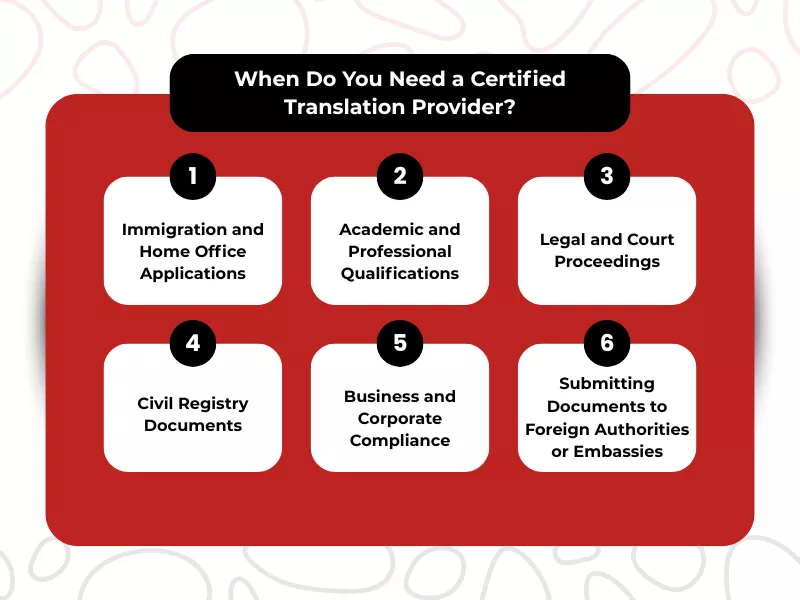
You basically need a certified translation provider whenever a UK authority, legal body, or foreign institution requires formal proof of the accuracy and authenticity of the translation. Here, the purpose of the translation is essential. However, the most common situations where certified translation is required are:
Immigration and Home Office Applications:
For visa, residency, and citizenship applications, certified translations must comply with Home Office rules. These translations are essential for birth certificates, bank statements, and criminal record checks, as authorities will not accept uncertified translations that lack a proper declaration.
Academic and Professional Qualifications:
Universities, ECCTIS, and licensing bodies often ask for translations accompanied by a clear accuracy statement. These translations matter because admissions teams rely on them to engage the services of qualified professionals and verify your credentials quickly.
Legal and Court Proceedings:
Courts require legal translations of contracts, evidence, affidavits, and judgments. Some international cases may require the use of sworn translators—professionals appointed by the government in their country—because only sworn translations offer the legal validity expected in those jurisdictions. In some instances, you may also need apostille services in addition to the translation.
Civil Registry Documents:
Birth, marriage, adoption, and death certificates are legal or official documents that need certified or sworn translations. Authorities will only accept versions that clearly certify a translation as accurate and complete.
Business and Corporate Compliance:
Companies involved in cross-border transactions often require certified document translation to ensure the translated document accurately reflects the original. This is especially important for powers of attorney, incorporation papers, and tax documents.
Submitting Documents to Foreign Authorities or Embassies:
Foreign embassies and overseas institutions have specific requirements for translations. Some demand notarisation; others expect sworn translations. In each case, the translation will depend on the level of formality required and the rules of the receiving country.
Now, let’s see how you can get Language Translation Services in the UK!
How to Get Certified Document Translations in the UK?
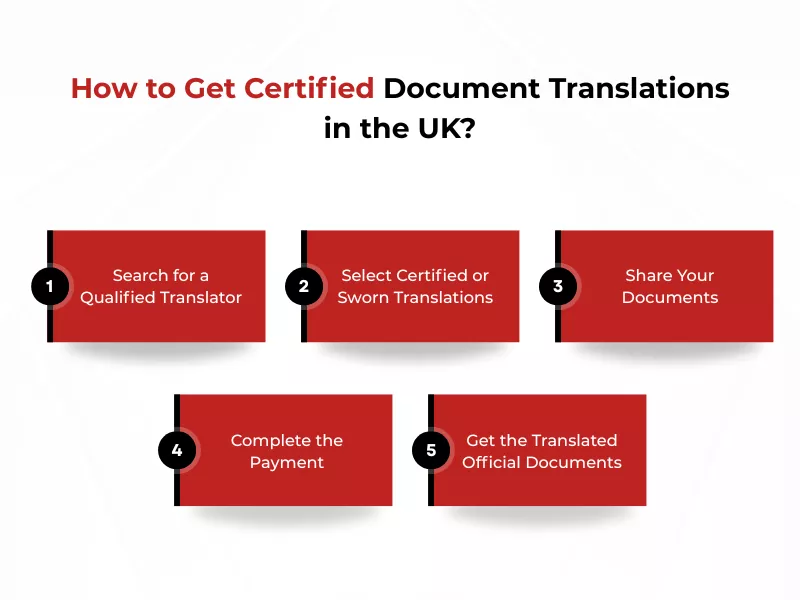
Search for a Qualified Translator
Your translator must be qualified and certified by CIOL, ITI, an Embassy, or a related body to provide certified translation. You can either search for a translator or contact a reputable translation agency like Translations.co.uk. (Always use Sworn translators if particularly mentioned.)
Select Certified or Sworn Translations
You then need to understand what type of translation you need. Convey the purpose of translation to the agency or linguist. Check with the respective authority to ensure you get the appropriate translation of official or legal documents.
Share Your Documents
Upload your document to their dashboard or share via email. The translator will review your requirements and provide you with a proper quotation. The translation prices on Translations.co.uk start from £15 in 150+ language pairs.
Complete the Payment
Once you receive the quotation, you must complete payment via bank transfer or card and share a screenshot with the team or translator. The translator will then translate your document.
Get the Translated Official Documents
Once you receive the translated document, match it with the requirements of the receiving authority. For instance, certified document translation must carry a stamp, signature, and declaration; authorities will not accept it otherwise. If everything is fine, you can submit it to the authorities.
Please note: The draft of a certified translation may not include all certification details, such as a stamp, signature, and declaration. The translator or agency might share it only for reviewing the name, date, and other content.
What Is Non-Certified Translation for Legal Matters and When Do You Need It?
When to Use Non-Certified Translations:
- For understanding evidence or documents before requesting a certified version.
- Acceptable when the document is only for internal legal context or background.
- Suitable when reviewing terms internally without submitting to authorities.
- Helps lawyers grasp the meaning before preparing official submissions.
- Ensures clarity for decision-making without formal requirements.
- Suitable when the budget is low and the timeframe is limited.
What Do You Need: Certified, Sworn, or Notarised Translation?
Situation 1: When You Need a Certified Translation
Real Case Example: An Indian national applying for a UK Spouse Visa submits their birth certificate, marriage certificate, and bank statements, all issued initially in Hindi. UK Visas & Immigration (UKVI) requires these documents to be accompanied by certified translations that include a signed accuracy declaration, the translator’s details, and the date.
Why Certified Translation Is Required: UK authorities must rely on the translated document as legally accurate. Without certification, the application would be delayed or refused.
Typical Documents Requiring Certified Translation:
- Birth and marriage certificates
- Visa and immigration documents
- Academic transcripts and diplomas
- Criminal record certificates
- Court submissions in the UK
Key Point: Translations.co.uk provides UKVI-compliant certified translations accepted by UK government bodies, courts, and universities.
Situation 2: When You Need a Sworn Translation
Real Case Example: A UK company is involved in a legal dispute in Spain and must submit contracts and witness statements to a Spanish court. The court requires the documents to be translated by a sworn translator officially authorised by the Spanish government.
Why Sworn Translation Is Required: Some countries only accept translations completed by translators who are legally sworn in before a court or government authority. These translations carry automatic legal validity in those jurisdictions.
Typical Scenarios Requiring Sworn Translation:
- Court proceedings abroad
- Legal disputes in countries recognising sworn translators
- Civil registry filings outside the UK
- International litigation
Key Point: Through its global network, Translations.co.uk arranges sworn translations for jurisdictions where sworn translators are legally required.
Situation 3: When You Need a Notarised Translation
Real Case Example: A UK resident purchases property in Italy and must submit a power of attorney and property deed to an Italian notary. The receiving authority requires the translation to be notarised, confirming the translator’s identity.
Why Notarised Translation Is Required: Notarisation adds an extra layer of legal authentication by verifying who translated the document, not the translation’s linguistic accuracy. It is often requested when documents are used internationally.
Typical Documents Requiring Notarised Translation:
- Property deeds and land registry documents
- Powers of attorney
- Company incorporation papers
- Documents submitted to foreign embassies
- Overseas inheritance or probate files
Key Point: Translations.co.uk supplies notarised translations prepared in line with international legal requirements and embassy standards.
Frequently Asked Questions
What Is a Legally Sworn Translator?
A legally sworn translator is authorised by a government or court to translate and officially swear that the translation is accurate. Their translations carry legal standing and are accepted for formal and judicial purposes.
When to Get a Notarised Translation?
Notarised translations are generally needed when a receiving authority requires the translator’s identity and signature to be legally verified by a notary, as is common for visas, academic records, overseas applications, and specific legal procedures.
How Much Does a Certified Translation Cost?
Certified translation prices vary based on language, document length, format, and urgency. Our prices for standard documents start from £25, with complex legal or technical texts costing more.
Do Professional Translators Need to Be Certified?
Not always. Many translators are highly skilled without formal certification. However, a certified or sworn status is required when providing translations for official, legal, or governmental submissions.
How Do I Know If a Translation Is Certified? Will UKVI Accept?
A certified or official translation includes a signed accuracy statement, the translator’s or agency’s details, date, and sometimes a stamp. It must clearly state that the translated document is a true and accurate representation of the original. Yes! UKVI accepts all translations done by our translators.
Is Certified Translation More Expensive Than Professional Translation?
Yes, certified translation is usually more expensive than professional (non-certified) translation in the UK, and the difference comes down to legal responsibility and acceptance requirements.
- Certified translation: Usually starts from £25 per document, depending on language pair, length, urgency, and formatting.
Professional (non-certified) translation: Starts from £15 per page, as it focuses purely on linguistic quality without legal validation.
RECEIVE A FREE NO OBLIGATION QUOTE

Want To See My Profile — Check Now
- Translation vs Interpretation: Understanding the Key Differences - 18th March 2026
- Difference between Certified vs Notarised Translation: A UK Guide - 12th February 2026
- How to Choose a Translation Company: 5 Key Factors to Consider - 28th January 2026