Since Brexit, the UK drug market has undergone dramatic shifts. In order to be compliant, manufacturers now have to deal with two sets of rules: EMA and MHRA. Both have high standards for drug safety, but operate differently and have different labelling requirements.
The EMA operates in a centralised manner in the 27 member states of the European Union. The MHRA, on the other hand, is a single UK regulatory body requiring separate dossier and review procedures.
The different rules outline how the product information should be presented and translated to various markets. Therefore, understanding the MHRA vs EMA labelling requirements is vital for ensuring patient safety and avoiding market delays.
Key Takeaways on MHRA vs EMA Labelling Requirements
- Britain is now a separate territory with its own rules, apart from the 27-nation European Union bloc.
- European distribution demands 24-language translations, whereas the UK market requires localised British English.
- The “UK Only” mark supersedes the previous shared packaging by the EU states’ system.
- Serialisation and tamper-evident barcodes are mandatory for EU stock but no longer required in Great Britain.
- Inverted triangles are an example of unique British safety cues that are vital to local compliance and patient protection.
What Are the EMA Requirements for Drug Labelling?
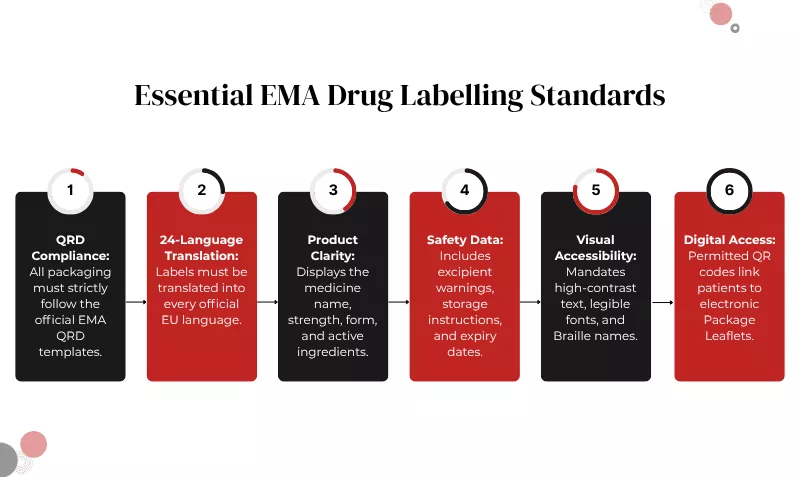
EMA stands for European Medicines Agency. As per the EMA medicine labelling requirements, the labelling must be accurate and legible while being compliant with Directive 2001/83/EC. The pharmaceutical labelling must adhere to the standardised EMA QRD Template and cover:
- Outer packaging
- Immediate container
- Package leaflets
Lastly, EMA labelling must be translated with the help of a professional translation service into the official language of the 27 EU member states, where the product will be marketed.
Mandatory Labelling Elements
The drug label and outer carton of each medicine must display the following key information clearly:
| Medicine Identification |
|
| Quantitative Listing of Key Ingredients |
|
| Administration |
|
| Safety & Storage: |
|
| Traceability |
|
| Marketing Authorisation Holder (MAH) Details |
|
EMA Rules Regarding Design, Formatting, and Layout
For legibility and maximum patient safety, there are particular design standards dictated by EMA:
- The text must high contrasted against the background.
- The font must be large enough for easy readability.
- Inclusion of visuals such as illustrations, pictograms, or body-part indications is allowed for patient understanding of medication application on how and where. Exclusion: toys or sweet images are forbidden.
- On the outer packaging, the medicine’s name should be written in Braille.
Inclusion of Electronic and Digital Elements
To make product info more accessible, EMA labelling is allowing a transition towards digital formats.
For example, outer packing can have QR codes and Data Matrix to directly link with ePL (electronic Package Leaflet) and the latest product information.
What Is MHRA Guidance for Drug Labelling?

MHRA stands for Medicines and Healthcare products Regulatory Agency. UK labelling regulations, as per MHRA requirements, include clear, legible drug packaging and labelling for the prevention of medication errors.
In the same field of view, all critical information regarding safe usage must be displayed prominently and printed directly on the packaging.
Core Drug Labelling Requirements of MHRA
|
Inclusions |
What They Contain |
The Rules |
|
Key Information |
|
This info must be grouped together. The details must not be broken up by logos or background graphics. |
|
UK Market Identifier as per Windsor Framework |
“UK Only” Statement (the rule implemented on 1 January 2025) |
Must clearly display on the Packaging for all medicinal products in the UK (Great Britain- England, Scotland, Wales). |
|
Controlled Drugs |
Include CD lettering |
Enclosed in an inverted triangle for controlled substances. |
Prohibited Practices for MHRA Labelling
- Over-labelling: New labels MUST NOT be applied over existing ones. Exceptions: displaying retail prices or local company details.
- Use of Promotional Imagery: The drug packaging MUST NOT have any attractive pictures (e.g. image of children) or website URLs for advertisement purposes.
Special Considerations for MHRA Drug Packaging
- Strict Identification for Clinical Trial: For Investigational Medicinal Products (IMPs), the MHRA encourages the labelling to have a specific wording. For example: “for clinical trial use only”. Plus, the outer packaging must have blinding protections.
- Readability: In the outer packaging, the medicine’s name should appear in Braille in order to accommodate patients who are visually impaired.
You can learn the complete information for compliance at the UK Government Guidance on Drug Labelling and Packaging.
MHRA vs EMA Labelling Requirements – Core Differences
MHRA (UK) and EMA (EU) regulations mandate strict labelling standards to ensure patient safety. However, the requirements significantly differ. Here’s a complete breakdown of distinctions by category:
|
Categories |
MHRA labelling Guidance |
EMA Labelling Guidance |
|
Market-Specific Packaging |
Must have “UK Only” labelled in outer packaging to be distinguishable from EU stock |
“UK Only” mark is non-permissible under strict multi-lingual, multi-state EU rules. EU stock is licenced for circulation across all member states simultaneously. |
|
Serialisation & Falsified Medicines Directive (FMD) |
EU’s FMD standards do not apply to medicines for the UK market (GB) circulation. |
Strictly enforces the EU Falsified Medicines Directive (FMD). Every authorised medicine’s outer carton must include:
|
|
Language & Translation |
English only language for-
|
Requires multi-lingual packaging using Professional Pharmaceutical Translation. Country-specific booklets and product information (PL) must be available in all official languages of the EU member states. |
|
PIL Lettering & Designations |
Encourages the use of “Tallman Lettering” to prevent confusion between look-alike/sound-alike drugs (e.g., chlorproMAZINE vs chlorproPAMIDE) For controlled drugs, an inverted triangle with the letters “CD” is now encouraged. |
The QRD Template is used for user testing across multiple market regions in the EU. |
|
Marketing Authorisation |
Follows the International Recognition Procedure (IRP) for prior marketing authorisations (launched on 1 January 2024, replacing EC Decision Reliance Procedure). |
Follows the centralised, decentralised, or mutual recognition procedures for post-authorisation. |
How to Navigate Dual Regulatory Landscapes of EMA and MHRA for Drug Labelling?
In order to navigate both EMA and MHRA landscapes, manufacturers must manage two different regulatory tracks. Here are some tips for achieving compliance for both territories:
- Address specific labelling requirements of UK and EU marketing by creating two dedicated strategies for EMA and MHRA compliance.
- Parallelly keep separate QP (Qualified Person) certification records and audit-ready documentation for each agency.
- Align your internal SOPs to accommodate both UK GMP addendums and EU Annex 1.
- Have a centralised matrix for mapping differences in documentation, licensing, and audit trails.
- Partner with a professional translation and localisation service provider for smooth language adaptation for different EU markets.
Lastly, you need to ensure cross-border regulatory and corporate documents are properly authenticated. This is because many submissions require compliance with Post-Brexit UK Requirements for Apostille and Legalisation before they’re accepted.
Need Translation & Localisation Help for Pharmaceutical Packaging and Labelling?
At Translations.co.uk, we have been providing pharmaceutical packaging and labelling translation and localisation services in accordance with EMA and MHRA standards.
With deep knowledge of post-Brexit UK and EU drug labelling requirements, our professional translators ensure complete compliance in our work. For complete safety, we also offer services for back translation in clinical trials of drugs.
All 24 official languages of EU member states are supported by our service. We have native translators in Bulgarian, Croatian, Czech, Danish, Dutch, English, Estonian, Finnish, French, German, Greek, Hungarian, Irish, Italian, Latvian, Lithuanian, Maltese, Polish, Portuguese, Romanian, Slovak, Slovenian, Spanish, and Swedish.
Contact our pharmaceuticals and medical translation services today for your EMA and MHRA packaging and labelling requirements for the UK and EU markets.
Conclusion
The separation of the UK from the EU has left drug companies with two paths to follow. Customised packaging is now critical to success in both domestic and international markets. Dealing with these different demands requires accuracy and a certain degree of specialisation. Tackling each market separately allows a company to avoid time delays and guarantee its product is legally compliant and safe for patients in both markets.
Frequently Asked Questions on MHRA vs EMA Labelling Rules
What does the “Blue Box” requirement imply for the European market?
The EMA mandates that there be a separate section of the packaging for country-specific information. This space is for local contact information/reimbursement code for each individual member state.
Do both agencies require the same type of patient readability testing?
Yes, both require “User Consultation” to make sure leaflets are understandable. The UK is based on local patient cohorts, whereas the EU needs testing in a wide spectrum of linguistic groups.
What are the specific needs of pregnancy prevention pictograms?
The MHRA specifies that certain medications are ‘high risk’ and require an additional ‘no entry’ pregnancy symbol on the exterior carton. The EMA also employs visual warnings, but the UK has tougher ‘Visual Risk Communication’ requirements on the size and conspicuous location of these safety icons.
Are there differences in how “distance selling” logos are used for online sales?
The EU adopts a standard green logo to identify genuine online pharmacies in EU countries. Following Brexit, the UK has set up its own domestic registry. Manufacturers are required to ensure that digital labelling will lead to the appropriate national verifying authority in the respective region.

Want To See My Profile — Check Now