
When someone asks, “What is correct English?”, many people view it as a rigid set of 18th century grammar rules. Linguists define it as standard English, which is used in professional, academic, and governmental settings.
More importantly, the correctness is not a fixed law of nature; it is a social agreement. Whether you are using British English, American English, or a local dialect, the “correct” form is the one that reaches your audience without distraction. In this blog, we will discuss the correctness of language and tips to speak the correct language.
Key Takeaways
- Context is the king; what may be correct in a text message might be incorrect in a legal brief.
- Standard vs correct; Standard English is used in formal communication, but it is not the only valid way to speak.
- Language changes over time; what was considered an error 50 years ago may be standard today.
- Dialect matters a lot. Spoken dialects have their own logic and correctness.
Defining the Meaning: What Does “Correct English” Mean?
The correct English meaning depends on who you ask. If you ask a strict grammarian, it means you have to follow the perspective rules. If you ask a linguist, the correct English definition is more about communicative competence.
Standard English vs. Correct English
It is a common misconception that standard English is the pure form of the language.
- Standard English: A standardized dialect used in broadcasting, education, and Language translation services.
- Correct English: A subjective term often used to describe adherence to Standard English.
While people debate about standard English vs correct English, linguists argue it is simply the most “prestigious” version. It was the dialect used by those in power when the language was being codified.
What Makes English “Correct”?
If there is no single “English Police” headquarters, then what makes English correct in the eyes of the public? It usually breaks down to these three factors:
| Factor | Description |
| Consistency | Using rules that allow a reader in London to understand a writer in Sydney. |
| Prestige | Following the “formal” rules taught in schools and used in a professional Translation service. |
| Clarity | Avoiding ambiguity so the meaning is never lost. |
What Counts as Correct English in Formal Writing?
In formal writing, the bar for what is correct English is much higher. You have to avoid slang, use precise punctuation, and follow traditional rules. This is especially true when preparing a French Translation for a legal or academic document. This is to make sure your work is taken seriously in a professional environment.
The Linguist’s Perspective: Is There a Correct English?
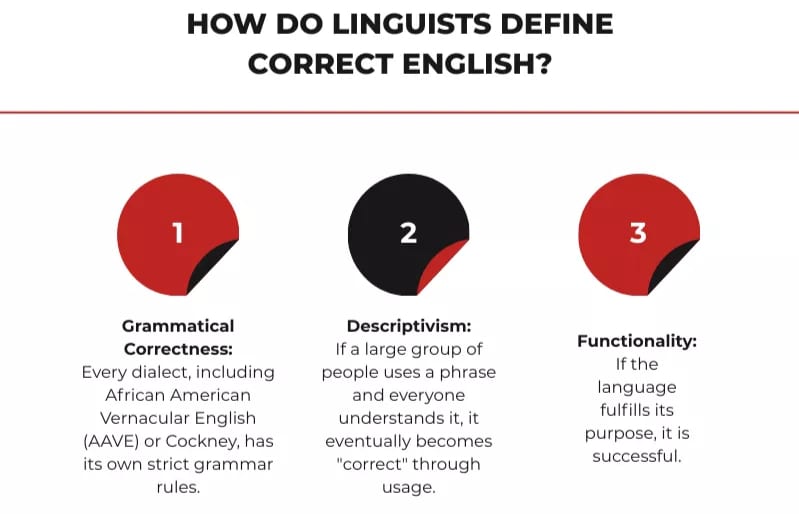
Linguists often ask, “Is there a correct English?” This is because they view language descriptively as how people talk, rather than how people should talk.
How Do Linguists Define Correct English?
Can Spoken Dialects Be Considered Correct?
Absolutely. But do dialects count as correct English? In their social contexts, yes. A person speaking a regional dialect is not failing at English; they are speaking a version of English that has its own history and logic. However, in a job interview or formal essay, switching to standard English is usually required to meet social expectations.
Why Do People Think English Has a “Correct” Form?
The idea of what’s correct grammar comes from a desire for order. Now, you must think about why do people think standard English is superior; it is historically tied to class and education. By labelling one version “correct,” society creates a shorthand for who has been properly educated.
Common Correct English Rules and Misconceptions:

How English Correctness Changes Over Time
Language is a continuously evolving thing. What you might think is correct English usage today would have been wrong 200 years ago.
- The “Thou” Era: We used to have formal and informal versions of “you”. We dropped “thou,” and the world did not end.
- The Rise of “They”: Using “they” as a singular pronoun is now considered correct English by most style guides, despite decades of being told it was an error.
- Technology’s Impact: Words like “Google” have turned from nouns into verbs or prepositions. Ten years ago, “I’ll Google that” might have been flagged; today, it is standard.
Practical Tips: How to Speak Correct English
If your goal is to excel in global business and media, here are a few pointers:
- Read Broadly: The best way to understand what counts as correct English in formal writing is to see it in action. You should read reputable news sources and literature.
- Understand Your Audience: If you are writing for a Mandarin Translation or a global audience, stick to the most neutral word choice to avoid confusion.
- Listen to Professional Speakers: Check your English broadcasters on how they use correct English to remain clear and authoritative without sounding stiff.
- Focus on Logic: Most grammar correctness issues come from a lack of logical flow. If your sentence structure is messy, your “English” feels correct, irrespective of your vocabulary.
Examples of Correct English Usage vs. Informal Usage

Both have their place. The “correct” choice depends entirely on whether you’re at a gala or a grill-out.
Final Thoughts
So, what is correct English anyway? It’s a tool. Like any other tool, its correctness is measured by how well it does the job. If you are exploring new words or just trying to write a professional Email, make sure that clarity is your ultimate goal.
Don’t be afraid of the rules of grammar and spelling mistakes. The most successful English speakers are those who know the rules well enough and know when and how to break them.
Frequently Asked Questions
How do linguists define correct English?
Linguists define correctness through communicative competence and the correctness of English grammar. If a native speaker says a sentence and the other native English speaker understands, it is considered “grammatical” within that person’s internal rule system.
What makes English “correct” in writing?
Writing is held to a different standard than speech because it is a formal, asynchronous technology. “Correctness” in writing is governed by standardisation, a process that creates a uniform code so that someone in London, New York, and Singapore can read the same document without confusion.
Can spoken dialects be considered correct English?
Yes, it can be considered correct English from a linguistic perspective. They are a grammatical rule-based, systematic, and fully functional system of communication used by native speakers.
Why do people think Standard English is superior?
People often perceive Standard English as superior due to prestige and power. Historically, the dialect spoken by those with the most wealth, education, and political influence became the “Standard.
What are common mistakes in “correct English”?
Common mistakes include confusing homophones, subject-verb agreement errors, misuse of apostrophes, and incorrect word orders.

Want To See My Profile — Check Now
- What Is Correct English? - 27th February 2026
- Why Is Leicester Spelled ‘Leicester’? - 12th December 2025
- An Introduction to Universal Grammar - 20th July 2016