
There are 10 common types of translation errors, and you can avoid them by reviewing translations more carefully, using a translation tool with human review, or hiring a professional translator with the required qualifications and certifications.
Translation errors can make headlines for all the wrong reasons. Whether you are a business or marketing professional or an individual travelling to the UK with foreign language documents, accurate translation is essential. While translation mistakes can jeopardise an organisation’s reputation, for an individual, they may lead to visa rejection.
In this guide, we will discuss the different types of translation errors, their consequences, and how to fix them. Let’s begin.
Key Takeaways: 7 Consequences of Translation Errors
- Direct financial impact of translation errors on businesses
- Regulatory delays and expensive submission processes
- Product recalls and market withdrawals due to safety errors
- Expensive rebranding costs from marketing missteps
- Customer trust erosion and lower conversion rates
- Legal liability from flawed employment or compliance documents
- Opportunity cost from delayed global market entry
Translation Error Classification: Types of Translation Mistakes You Must Be Aware of
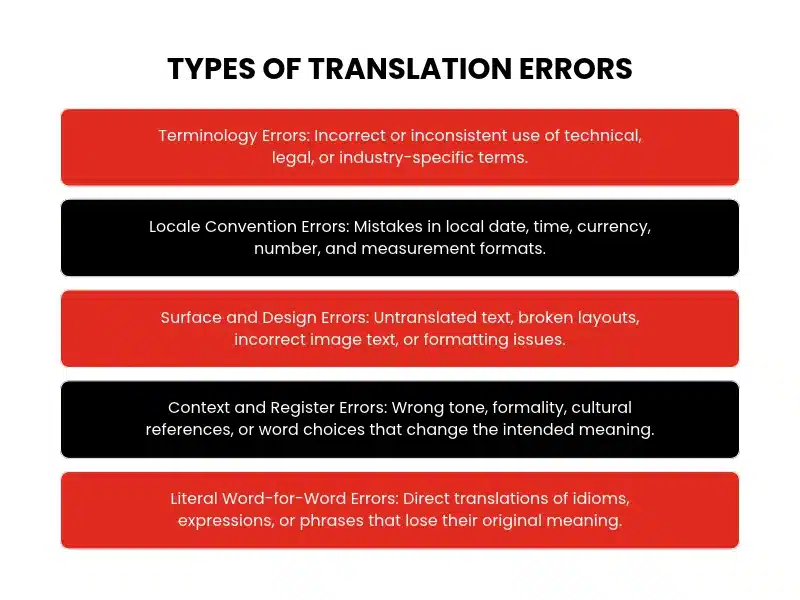
Making date and number format errors in translation and translating “Finger Licking Good” into “吃掉你的手指 (Chī diào nǐ de shǒu zhǐ)” are not the same. Translation mistakes in legal and compliance papers can become legal issues, while marketing translation errors can cost you millions. Thus, we, as translation service providers, have a few categories for translation error severity classification.
Let’s go into detail:
Terminology Errors
Not all words need to be translated from the source text to the target language, such as legal jargon, scientific and medical terms, etc. Using non-technical terms in the translated content is seen as mistranslated material. Furthermore, not using the same translated terms across multiple documents in a business setting causes inconsistency. This is where a translation glossary comes into play.
Locale Convention Errors
During translation, translators must watch for date formats, incorrect numerical patterns, currency formatting, and unit conversions. Relying solely on machine translation tools leads to mistranslation. During translation, translators must pay attention to local nuances to avoid mistakes in the project.
Surface and Design Errors
In email marketing, SEO translation, and e-commerce translation, localisation plays a significant role. Untranslated CTA buttons, broken layouts from increased text, or untranslated images and alt text for foreign products leave a negative impression on SERP, LLMs, and visitors.
Literal Word-for-Word Errors
For standard documents, literal translations are acceptable. But in marketing copy, they can have serious consequences. For instance, the phrase “it’s raining cats and dogs” in Spanish should be “Está lloviendo a cántaros.” However, if the translator translates it literally, it will be “it’s raining pitchers. These translation errors can take the life out of the original language in marketing translation services.
Context and Register Translation Errors
One of the most common translation mistakes is using “Sei” instead of “Du” in German translation. Furthermore, translation tools and freelancer translators often do not take the context into account, leading to mistranslation of multiple words with similar meaning. Lastly, without native translators, cultural blind spots regarding local humour and customs are common translation errors.
Why Do Translation Errors Occur?
- Lack of subject-matter expertise among translators. Many businesses don’t hire native speakers or professional translation services, assuming freelancers can do the same.
- Non-native target translations that ignore the mother-tongue principle. For business documents, localisation is often the first step, and it’s ignored.
- A translation management system is never enough if you work without termbases, glossaries, or style guides.
- Poor source text quality with ambiguous pronouns and structure, caused by over-reliance on unreviewed machine translation and neglecting the target audience.
- Translations fail when there is no independent revision or a two-stage workflow, underscoring the importance of AI vs Human Translation.
- Tight turnaround and volume pressure lead to quality shortcuts and a lack of contextual information in project briefs.
How Can I Check a Translation If I Do Not Speak the Language?
Even without knowing the target language, you can verify translation quality by applying specific QA practices:
- For high-quality translations, always have a trusted native speaker review the translated text in its final visual layout.
- Do not solely depend on translation memories; use a separate translation engine to back-translate clinical trials and key sentences into your source language to catch obvious meaning shifts.
- Create a separate translation glossary for every translation project, and inspect the text on the live page or document preview to verify that formatting and button layouts remain intact during e-commerce translation.
What Is the Difference Between a Translation Error and a Stylistic Preference?

A translation error is a clear, objective flaw in a translation by an AI or human translator. Poor translations fail in accuracy, terminology, grammar, locale conventions, or required register. From mistranslating a legal clause to omitting information and using incorrect date formats, poor translation quality can damage brand reputation and lead to legal consequences.
On the other hand, stylistic preference refers to subjective variation in word choice, sentence rhythm, or phrasing when multiple grammatically correct options exist without changing the factual meaning, and it requires a review of the business translation guide to match the brand image.
How Do Missing Words Change the Meaning of a Translation?
Ever wondered why a professional translator’s linguistic skill matters so much? It is to avoid these mistakes in translations:
- Reversal of Intent in NMT: Neural Machine Translation engines sometimes drop critical negation words (e.g., rendering “shall not be liable” as “shall be liable”), which inverts legal meaning while leaving the sentence grammatically smooth.
- Legal and Regulatory Exposure: Dropping words or clauses in legal or commercial documents can eliminate contractual obligations, remove liability protections, drop safety warnings in product manuals, or remove mandatory allergen declarations.
- Loss of Meaning (Undertranslation): Mostly happening during localisation, omitting words simplifies the original content, resulting in incomplete messaging or distorted intent.
For instance, Apple’s global slogan for the iPhone 7 was “This is 7.” When localising this for the Cantonese-speaking market in Hong Kong, the phrase was translated directly to “這就是 iPhone 7” (This is iPhone 7), losing its punch!
More critically, in Hong Kong Cantonese, the number “7” (柒, chat) is a common, localised slang word used to describe someone or something as “clumsy,” “awkward,” or “ridiculous.”
Can a Bilingual Employee Reliably Spot Translation Errors?
Just because someone can speak two languages fluently does not mean they can translate well. Translation isn’t just converting a word from one language to another; it’s also more complex, requiring professional translation training, domain-specific knowledge, and mastery of localisation assets like glossaries and style guides.
In marketing campaigns, you must avoid translation errors, as they can lead to embarrassing mistakes like HSBC’s. Also, not knowing the different meanings of the same word can lead to using 7 in the wrong context.
If you need high-quality translations that resonate with your target audience, match local meaning and tone, and ensure your message reaches people clearly, you cannot rely on a bilingual employee! Hire a professional translator or agency. Translation agencies also save costs in the long term by conducting a review by native speakers or community leaders to ensure your message is clear in both the source and target languages.
What Are the Most Common Translation Errors in Official Documents?

Wondering about mistakes to avoid in personal documents? Here are the common translation errors for you:
- Omissions: Dropping required clauses, personal details, stamp text, signatures, or metadata.
- Register Mismatches: Using conversational language in formal government or legal filings.
- Complex Sentence Mistranslations: Misinterpreting long multi-clause sentences, double negations, or undefined acronyms.
- Locale Convention Errors: Keeping original date formats (e.g., confusing DD/MM with MM/DD), decimal separators, or measurement units.
- Terminology Inconsistencies: Translating defined legal terms, official titles, or regulatory vocabulary differently across sections of a document.
- No Certification: Not using a certified translation service and submitting a translation without a translator’s stamp, certification details, and declaration.
Is Machine Translation Reliable for Legal or Immigration Documents?
No. No matter how advanced translation tools you use, you should never publish or submit raw machine translation for legal, regulatory, or official documents. While many individuals choose machine translations to meet urgent translation requirements, NMT engines can invent names, numbers, or dates, and struggle with complex conditional legal phrasing. Therefore, always choose human-assisted machine translations. This will help identify errors, ensure that the translated content is accurate, and matches the formatting required by the authorities.
How Do Translation Agencies Prevent Errors in Certified Translations?
At Translations.co.uk, we have been offering document translation services since 2002. To avoid wrong translations, we follow the process below to maintain high-quality translation without exceeding the pricing range.
- ISO 17100 Two-Stage Workflows: Assigning one qualified translator to translate and a second independent native linguist to revise every segment against the source.
- Enforced Termbases & Glossaries: Locking approved legal, technical, and regulatory terminology into CAT tools to block unauthorised terms.
- Pre-Translation Source Review: Analysing source files before work begins to resolve ambiguous clauses and undefined acronyms.
- Automated QA Software: Running checks (such as Xbench or Verifika) for missing text, number discrepancies, broken tags, and formatting slips.
- Style Guides & Visual Context: Providing translators with tone guidelines and real-time visual page previews.
A Checklist to Review the Translations Before Final Submission
From reviewing official document translation services to professional marketing content, this checklist will help you review the documents before the final submission or publication:
- Meaning & Accuracy: Confirm the text accurately conveys the source meaning without word-for-word false friends or dropped negations.
- Completeness: Verify that no clauses, headers, footers, stamps, metadata, or form fields were left untranslated or omitted.
- Terminology Consistency: Ensure all key legal, technical, and brand terms adhere to your project glossary.
- Locale Conventions: Validate that dates, numbers, currency symbols, and measurement units follow target market standards.
- Register & Tone: Ensure the formality level matches the official or commercial document requirements.
- Layout & Text Expansion: Review the document layout to ensure expanded target text fits within page designs.
- Automated QA & Native Review: Run automated software checks and ensure an independent native linguist has reviewed the final text.
Conclusion
Translation errors can occur due to several reasons, including human error, lack of knowledge, subjective errors, and the incorrect use of terminology or grammar. Even a small mistake, such as the wrong placement of words, can change the meaning of a message. When an English source is translated literally into another language, the translation may lose its original intent, sound unnatural, or fail to reflect cultural sensitivity.
Working with professional translation companies can help translators avoid these issues through subject-matter expertise, independent proofreading, and quality assurance. Experienced translation partners understand the main types of translation errors and know how to make translations accurate, culturally appropriate, and relevant to the target audience. Reviewing past translations, maintaining consistent terminology, and involving native linguists can also reduce translation errors and deliver reliable translation outcomes.
Ultimately, accurate translation is not simply about making two languages speak the same language. It is essential to ensure the accuracy of every detail so that your message reaches the intended audience without confusion, omissions, or incorrect translations. Choosing the right translation partner ensures that your message retains its original meaning, tone, and purpose across languages.
Frequently Asked Questions about Translation Errors
What is the most common translation mistake?
Common translation errors include replacing words without conveying the intended meaning, context, grammatical errors, inconsistency, or unnatural phrasing.
What is a translation error in a business context?
A translation error is a failure to meet the agreed requirements for accurate, appropriate translation. In business, this can include changing the meaning of a contract clause, using incorrect product terminology, omitting an instruction, or misrepresenting a price, date, or quantity. Translation assessment frameworks recognise errors involving meaning, terminology, numbers, and other specifications; not just grammar.
Can ISO 17100 certification guarantee zero translation errors?
No. ISO 17100 certification provides assurance about a provider’s translation processes, resources, and ability to meet applicable specifications; not a guarantee that every translated material is error-free.
How does a translation error differ from a translation quality issue?
A translation error is a confirmed defect. For instance, a bad translation means something violates the source meaning, a language rule, or the agreed specifications. In the Multidimensional Quality Metrics (MQM) framework, a translation quality issue is a potential error flagged for evaluation. Quality Assurance process may ultimately confirm it as a translation error, treat it as a preference, or reject it as a false alarm.
Can I publish machine translation directly? Is it good enough to publish?
No. For marketing materials, legal documents, medical papers, and public-facing business content, human post-editing or professional human translation is the safer choice. This is because machines can’t maintain consistency, may produce word-for-word translations, or fail to understand local conventions, leading to translation blunders.

Want To See My Profile — Check Now
- What Are the Types of Translation Errors, and How Can You Avoid Them? - 10th November 2026
- Errors in Original Documents, Not the Translation? Learn How to Fix! - 9th October 2026
- Which Version Should You Translate When Your Documents Have Passed Through Multiple Countries? - 16th September 2026