
A UK-born child. A Thai parent. An official in Thailand who can’t read English and has never handled a UK Certified Copy of an Entry before.
That’s the reality of using UK civil documents overseas. The language barrier is rarely the hard part. The hard part is making sure the translation will actually be accepted, in the right format, with the right certification, before an application, appointment or deadline is on the line.
We took on this birth certificate with that in mind, working out what the receiving authority would need to see before translating a single word, so the document landed in the right hands in the right form the first time.
Our Work
| Who | individual needing a UK birth certificate recognised in Thailand. |
| Service | CIOL Certified Translation |
| Languages | English → Thai |
| Documents | UK birth certificate (Certified Copy of an Entry) |
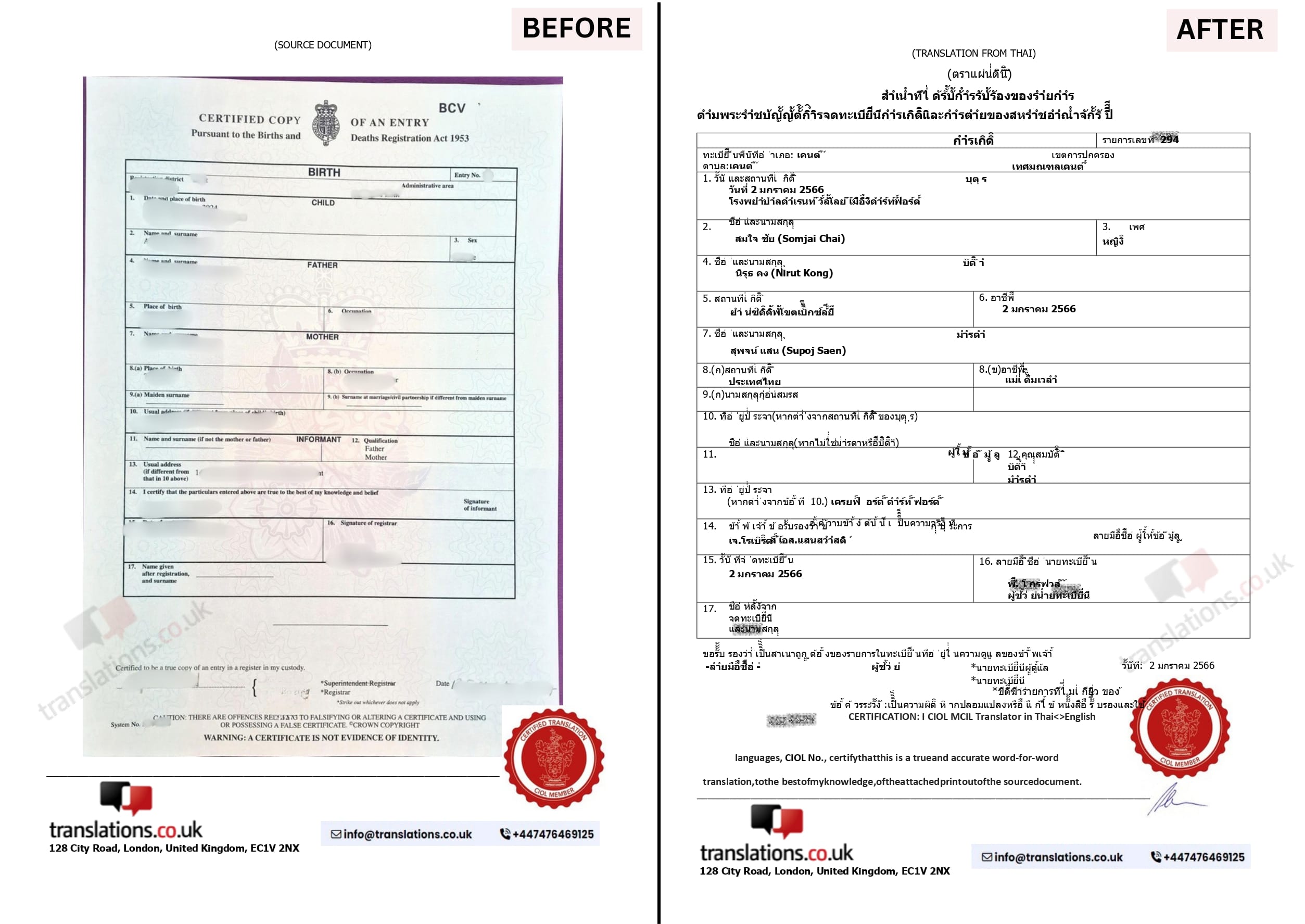
The Case Study Covers:
- A 17-field UK birth certificate and a Thai-speaking reviewing authority
- How we kept every field, name and date verifiable against the source
- What the client received, and why it was built that way
Client Background
The family needed a translation of their child’s UK birth certificate for a visa process, with a 48-hour deadline. The document came with three problems:
- The reviewer would read only Thai, but needed to check every detail against the English original.
- The names had to match passports and other identity records exactly.
- The certification had to be one the receiving body would accept, from a translator whose credentials could be verified.
The question wasn’t just “can this be translated?” It was “what will make this translation accepted?”
Challenges
Birth certificates are among the most scrutinised documents in immigration, citizenship and civil registration cases. This one added some specific difficulties:
- Legal terminology: “Administrative area”, “Superintendent Registrar”, “Informant” and the reference to the Births and Deaths Registration Act 1953 have no one-to-one Thai equivalents.
- Names and places: Thai readers need Thai-script renderings, while officials still need the Latin-script originals to verify identity.
- Different calendars: Thai official documents use the Buddhist Era, 543 years ahead of the Gregorian calendar. A date copied across unchanged would look wrong to a Thai reader.
- Everything on the page counts: strike-through instructions, footnotes and the security warning all had to be translated, not dropped.
- Getting it wrong costs time: a rejected translation means re-certification and resubmission, which can mean missing the deadline.
Solution
We didn’t just translate the text. We built the document around what the reviewer would need.
- Mirrored layout: the birth certificate translation reproduces the original’s numbered boxes (1–17), header and footer notes, so a caseworker can compare the two documents side by side.
- Dual-script names: every personal name appears in Thai script with the Latin spelling in brackets, so identity checks against passports and other records are straightforward.
- Calendar conversion: dates are given in Buddhist Era, following Thai administrative convention.
- Phonetic place names: hospital, district and county names are transliterated into Thai, with the original spelling kept where it matters.
- Certification: the translation closes with a CIOL MCIL translator declaration confirming a true and accurate word-for-word rendering, backed by a CIOL Member stamp and signature.
- One package: source and translation sit together, branded and traceable, so the receiving authority sees a single, coherent file.
Results
What the client received:
- A fully mirrored Thai translation covering all 17 fields, annotations and footnotes
- Names verifiable in both scripts
- Dates in the format Thai authorities expect
- A CIOL-certified declaration with a verifiable translator credential
- A single file pairing the source and the translation
Conclusion:
The client didn’t need to understand Thai registry conventions, Buddhist Era dating, or CIOL certification wording. They just needed their document to be accepted.
That’s really what this comes down to: a translation service knowing what the receiving authority expects well enough that you don’t have to find out the hard way. One document, one rulebook, done right the first time.