
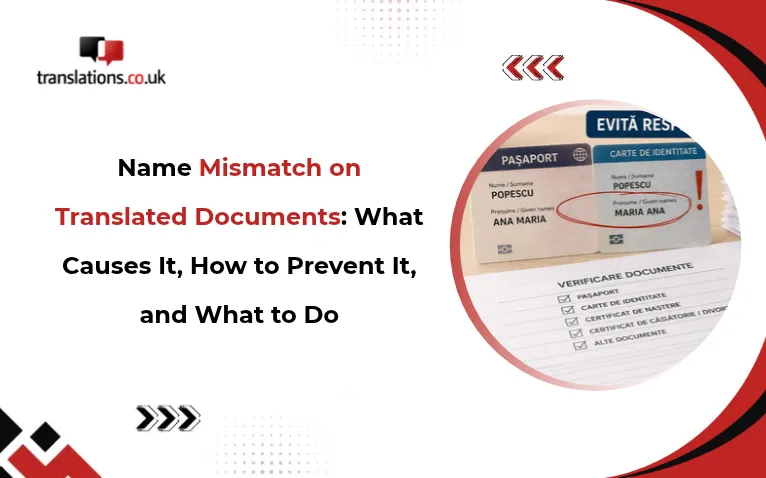
Is your visa delayed because of a name mismatch on translated documents? This can happen because UKVI commonly compares your passport, application form, original documents, and certified translations for consistent names, dates, and identity details.
A name mismatch on translated documents can not only delay a UK visa decision but, in some cases, also contribute to refusal. A refusal is more likely if the name mismatch is unexplained or makes it unclear that all documents refer to the same person.
If you’re unsure what caused it, how to prevent it, or what to do to avoid it, this guide is for you.
Key Takeaways: What Causes the Name Discrepancy Across Documents?
- Use the spelling on your current passport as the primary reference when completing your UK visa application.
- Differences can result from transliteration rules, regional variations, name order, missing middle names, or errors in the original document or translation.
- Always ask a qualified translator to work from the original-language document rather than relying on an older translation.
- Translators must accurately reproduce the source document. They should not independently correct or replace a name with a different spelling.
- If your name has legally changed, submit relevant evidence such as a marriage certificate, deed poll, or official name-change certificate.
- If the discrepancy was introduced by the translator, contact the translation provider and request a corrected version.
- Providing your passport and explaining the spelling variations before translation helps the translator maintain consistency and identify potential discrepancies.
- If the original document contains a different spelling, provide a clear explanation and supporting evidence to establish that both names refer to the same person.
Do Name Differences Affect a UK Visa or Passport Application?
Yes. Name differences can actually affect both a UK visa application and a UK passport application, but the impact depends on whether you explain the difference and support it with evidence.
| UK Visa Applications | UK Passport Applications |
| If documents do not align, a caseworker may request clarification or additional evidence, which delays the decision. | If the name on your foreign documents does not match your application, HMPO may ask you to correct the foreign document or explain the discrepancy before issuing the passport. |
A name discrepancy across documents can lead UKVI to request further information, asking for a corrected certified translation or evidence explaining the difference. Unfortunately, this can delay the visa process.
Which Name Spelling Should I Use When My Old Translation and Passport Use Different Spellings?

If your name spelling in certified translations does not match your current passport, use the spelling on your current passport for your visa application. However, if you have formally changed your name and have official evidence of the new spelling, you can submit it as supporting evidence with your visa application.
HMPO expects applicants to use one name consistently for all official purposes, and the passport is the key identity document UKVI will compare against.
Should I Translate the Original Document or an Older Translation When Names Differ?
You should translate the original document directly, rather than basing it on an older translation, and when you do so, keep the following in mind:
- Hire a qualified translator to produce a new translation from the original document, instead of correcting or overwriting the old translation yourself.
- Translations should faithfully reproduce the source, so you must keep the original-language name exactly as written in the source document.
- You can ask the translator to add a note if there is an error in the original document. For example: “The name is transliterated as ‘X’ in the original document; the applicant’s passport uses ‘Y’. Both represent the same name.”
- You can also attach a short covering letter explaining the name transliteration in certified translations and that your passport spelling is the one you use for all official purposes.
- If your source document has passed through multiple countries, you must know which document version should you translate to avoid getting flagged for incorrect document translations.
Does an older translation spell your name differently from your passport? Get a quote for a certified translation based on the original document.
Should the Name in a Certified Translation Match My Passport?
Yes. The English translation of your name in a certified translation should normally match your passport spelling. For UKVI, the name in your passport is the main reference for your identity. For HM Passport Office, the reference is the name you are applying in, supported by your birth certificate or name-change evidence.
However, the translator must still accurately reproduce the name as it appears in the original-language document; if that differs, the translation should include a clear explanatory note.
Can a Translator Change a Spelling Mistake in My Original Document?
No.
A translator will not correct a spelling error in your original document. A certified translation must faithfully reproduce the source, so changing a name would make it inaccurate. That is why one of the mistakes to avoid when translating documents is departing from what the source document actually says.
I’m Applying for My First UK Passport. What’s the Reference Spelling?
If you don’t yet have a UK passport, the passport can’t be your reference. HM Passport Office expects you to apply using the name you use for all official purposes, and that name must match your supporting documents, such as your birth certificate. If the name you use now is different from the one on your birth certificate, you’ll need change of name evidence (for example, a marriage certificate, a change of name deed or a statutory declaration). Your certified translation should still reproduce your birth certificate exactly as written. The name-change evidence is what links the two names.
Why Does My Name Appear Differently on Translated Documents?

Your name might appear differently on translated documents for multiple reasons. Here are the most common reasons:
Transliteration & Romanisation Rules
Converting a name from a non-Latin script into Latin/English letters is not an exact science. Different systems produce different spellings for the same sound. This can disrupt consistent name spelling across documents.
Regional or Dialect Variations
Varying phonetic or administrative spelling conventions across different regions or local dialects in the same country can cause name discrepancies.
Strict Source-Text Adherence
A professional translator must translate the document faithfully from the source to the target language. If your local birth certificate spells your name differently from your international passport, the translation will reflect the same variation.
Independent Translators
Documents are often translated at different times by different translation services or agencies. If Translator A and Translator B use slightly different phonetic rules, the spellings will diverge.
Name Order and Initials
In the UK, the given name comes first and the surname last; in Korea, China and Japan, the surname comes first. Cultural differences in name order on translated documents, or the inclusion/exclusion of middle names and initials, can change how a name appears.
How Should a Maiden Name and Married Name Be Handled in Translations?
When translating a maiden name and married name, the translator must reproduce the name exactly as it appears in each source document; the link between the two names is shown through supporting evidence such as a marriage certificate.
- Preserve Legal Identity: Official documents such as translations of passports, birth certificates, court decrees and visas must reflect the exact legal name written on the primary document, including any middle name missing from official documents elsewhere, or transliterate it strictly according to official standards (such as ICAO guidelines for passports).
- Identify the Structure: Qualified professional translators first determine whether the target culture uses a patrilineal name change, keeps birth surnames, or uses dual/hyphenated names to understand how to handle maiden and married names in document translation.
- Avoid Unofficial Invention: Applicants and translators must avoid translating or changing a surname’s meaning. Names are proper nouns and must be transliterated or transcribed phonetically rather than translated literally.
Does your birth certificate show your maiden name while your passport shows your married name? Ask our team what to share before we translate your documents.
How Should Names from Arabic or Cyrillic Be Written in a UK Certified Translation?
In a UK certified translation, names from Arabic, Cyrillic, or other non-Roman scripts must be transliterated (represented phonetically in the Roman alphabet) rather than translated. For geographical terms, and as a reference where no existing ID spelling exists, translators may consult the PCGN romanisation tables published on GOV.UK.
Here is the key rule for writing names that applicants and translators must remember:
The safest approach for applications to UK authorities such as UKVI is for the spelling of names in the translation to align with the spelling on your passport. Therefore, do not use an academic or scientific romanisation from scratch if it differs from what is printed on your passport.
For instance, imagine you are an Egyptian applicant submitting your Arabic birth certificate to UKVI.

- Your Name in Arabic: محمد سعيد
- Academic/Scientific Romanisation: Muḥammad Sa‘īd (or commonly Mohammad Said)
- Your Current Passport: MOHAMED SAYED
In this scenario, the translator must use MOHAMED SAYED to match the passport perfectly. Because the original is in Arabic script, there is no Latin spelling to copy, so the translator romanises the name as MOHAMED SAYED to match your passport.
If the translator strictly follows the standard phonetic rule and writes “Mohammad Said”, a UKVI caseworker may query it as a name mismatch. This can cause visa delays or refusal because the birth certificate translation does not match the primary ID.
What Should I Send a UK Translator When My Documents Use Different Versions of My Name?

When your documents contain different versions or spellings of your name, you should send the translator a comprehensive “Name Reconciliation Kit” alongside your source texts. Providing this context upfront helps avoid translation delays and reduces the risk of your application being queried.
Here is exactly what you should send to your UK translator:
1. A Clear Digital Copy of Your Primary ID
Send a high-quality scan or photo of your valid international passport (or the passport of the person named in the documents).
- Why: This acts as the “Anchor Spelling.” In the UK, UKVI treats your passport as the main reference for your identity. The translator will use this spelling as the reference when romanising names from non-Latin scripts.
2. A “Name Mapping” Cheat Sheet
Create a short, typed text note or table that maps out the variations. Do not rely on the translator to guess which name belongs to whom if spellings vary wildly. Lay it out clearly:
- The Target Spelling: “My preferred/passport name is: [First Name] [Last Name]“
- The Variations: List the specific documents and how the name appears in each. For example:
- Birth Certificate (Arabic/Cyrillic): Displays the original name.
- University Degree (Latin script): Spelt as [Alternative Spelling] due to a previous university transliteration rule.
- Marriage Certificate: Spelt as [Alternative Spelling] due to a clerical typo.
3. Proof of Legal Name Changes (If Applicable)
If the differences in your name are not just spelling or transliteration variations, but actual legal changes (e.g., taking a spouse’s surname, dropping a middle name, or a formal deed poll), you must include:
- The Marriage Certificate, Divorce Decree, or Deed Poll that legally bridges the gap between Name A and Name B.
4. Explicit Instructions on “Translator’s Notes”
Ask the translator to use bracketed Translator’s Notes [TN] within the body of the translation to account for the discrepancies legally.
- Example of what they will add: “Paragraph 2 reads [Spelling A], which corresponds to the passport spelling [Spelling B] for the same individual. — TN”
- This signals to the UK caseworker that the translator noticed the variation and recorded it, rather than making a typo.
Will Our Translators Add a Translator’s Note or Reconcile Names on Request?
Our professional translators can add explanatory notes in the body of the translated document, or attach them separately to the Certificate of Accuracy. What they won’t do is change a name simply to match another document. The translation must reflect the source, and any spelling difference is flagged rather than silently corrected. If a name is unclear in the original, we may contact you for clarification before completing the translation.
What Should I Do If My Passport and Certified Translation Show Different Name Spellings?

If your passport and certified translation show different name spellings, don’t ignore the discrepancy. Review both documents and identify whether the difference comes from transliteration, an error in the original document, or an inconsistency introduced during translation.
Here are five steps you can take to resolve the issue:
1. Compare Your Passport and Original Document
Start by checking the name on your passport against the name on your original birth certificate or other supporting document. Identify whether the difference already exists in the original records or appears only in the translation.
2. Contact Your Translation Provider
If the discrepancy appears in the translation, contact your translation provider. Explain the spelling difference and share a copy of your passport so the translator can review the appropriate spelling and transliteration.
3. Request a Corrected Certified Translation
If the translator has made a spelling or transliteration error, request a corrected translation. Ask the provider to ensure that the revised document accurately reflects the original content and uses the established spelling of your name where appropriate.
4. Keep Supporting Identity Documents
If the original document itself contains a different spelling, you may need supporting evidence to establish that both names refer to the same person. Depending on your circumstances, this could include an affidavit, official name-change certificate or other government-issued identity records.
5. Explain Any Remaining Discrepancies
If the spelling difference cannot be corrected because it appears in the original document, provide a clear explanation when submitting your UK visa application. Include relevant supporting evidence so UKVI can understand why the names differ.
Conclusion: How Can You Avoid Name Mismatches in Certified Translations?
A name mismatch on translated documents does not automatically mean your UK visa or passport application will be refused. However, unexplained differences can create doubts about your identity, lead to requests for additional evidence, and potentially delay the application process.
The best way to avoid these complications is to check your original documents against your passport before requesting a certified translation. If your name appears differently across documents, explain the variations to your translator and provide supporting identity or name-change evidence where necessary.
At Translations.co.uk, accurate document translation starts with understanding the source document and the purpose of the translation. Whether you need a birth certificate, marriage certificate, academic record, or legal document translated, working with a professional translation provider can help you identify spelling inconsistencies and ensure that the translation faithfully reflects the original document.
Need a certified translation for your UK application? Contact Translations.co.uk to discuss your document requirements and get help with your translation.

Want To See My Profile — Check Now
- Name Mismatch on Translated Documents: What Causes It, How to Prevent It, and What to Do - 19th November 2026
- Birth Certificate for Immigration: A Major Requirement - 4th June 2026
- How to Translate a Foreign Birth Certificate for a UK Passport Application - 6th April 2026